
What Is the Buoy in a Box?
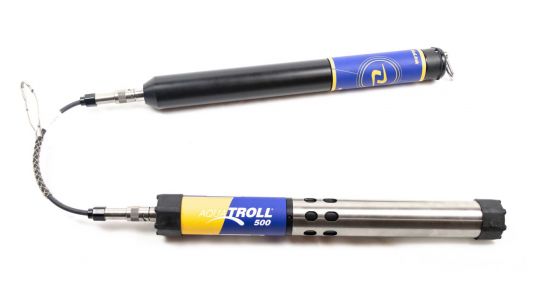
Most lake managers know the frustration: you need continuous water quality data, but getting from "we should monitor this" to "we have data" involves weeks of vendor calls, integration headaches, and expensive on-site installation. Buoy in a Box was designed to eliminate all of that. LakeTech ships a complete, pre-configured monitoring system directly to your dock. The buoy, sensors, telemetry unit, mooring hardware, and cloud dashboard access all arrive in a single shipment, ready to deploy. There is no multi-week integration process, no third-party installer, and no surprise costs. The price of about $10,000 includes free shipping and startup support from our team. This is one of our two most popular customer configurations. The other is a streamlined top-and-bottom RDO (Rugged Dissolved Oxygen) sensor setup for sites that primarily need to track oxygen stratification. The Buoy in a Box is the right choice when you want the full picture: a multiparameter surface sonde paired with a secondary depth sensor to capture what is happening throughout the water column.
- Complete system ships ready to deploy with minimal field setup
- About $10,000 includes buoy, sensors, telemetry, mooring, and cloud access
- Free shipping and startup coordination with LakeTech
- Alternative configuration available: top-and-bottom RDO sensors for oxygen-focused monitoring
What It Measures
The Buoy in a Box is built around a multiparameter sonde at the surface equipped with a mechanical wiper that automatically cleans the sensor face on a set interval. Biofouling is one of the biggest threats to long-term data quality in lakes, and the wiper dramatically extends the time between manual cleaning visits. At the surface, the sonde measures five parameters simultaneously: pH, dissolved oxygen, temperature, conductivity, and turbidity. Together, these give you a comprehensive snapshot of the lake's chemical and physical condition in real time. Approximately 10 feet below the surface, a secondary sensor measures dissolved oxygen, temperature, and conductivity. This depth targets the upper hypolimnion in most stratified lakes, which is where oxygen depletion events typically begin. Catching these changes early is critical for preventing fish kills, managing nutrient loading, and understanding seasonal turnover dynamics. The depth can be adjusted longer depending on your site conditions and lake morphology.
- Surface sonde: pH, dissolved oxygen, temperature, conductivity, turbidity
- Built-in wiper keeps surface sensors clean between maintenance visits
- Secondary sensor at approximately 10 feet: dissolved oxygen, temperature, conductivity
- Depth is adjustable based on site-specific bathymetry and stratification patterns
How the Data Gets to You
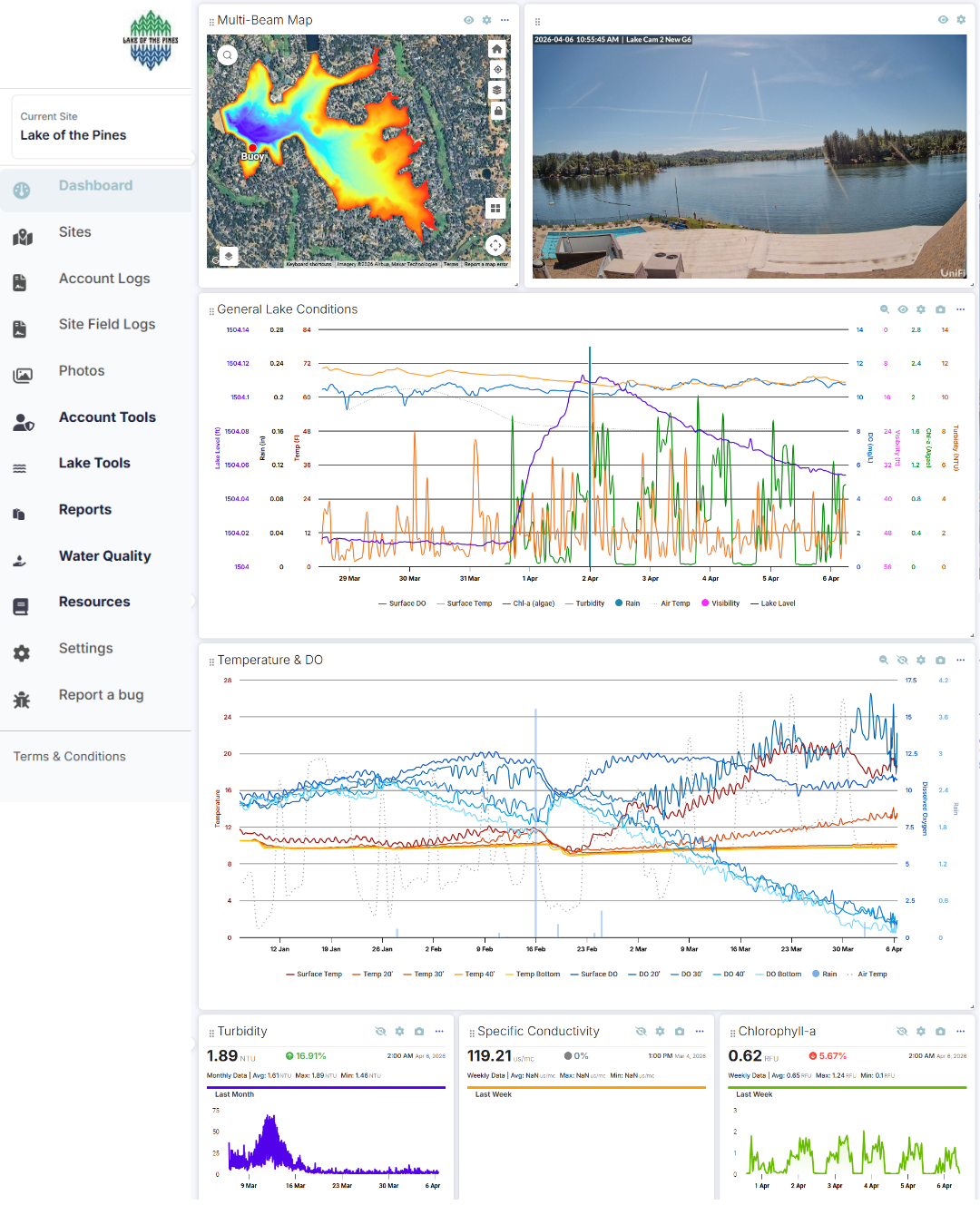
The system collects hourly readings and uploads data every four hours via cellular telemetry. This upload schedule is intentionally designed to maximize battery life while still giving you the temporal resolution needed to catch meaningful water quality events like overnight dissolved oxygen crashes or rapid turbidity spikes after storm events. All data flows directly into the LakeTech cloud platform, where it is processed, stored, and displayed on your personalized dashboard. You can view current conditions, historical trends, and multi-parameter overlay charts from any device. Automated threshold alerts notify you when a parameter crosses a value you define, so you do not need to check the dashboard constantly to catch a problem. The telemetry unit is compact and sits inside the buoy housing, protected from the elements. It uses standard cellular networks, so there is no need for on-site Wi-Fi, radio infrastructure, or line-of-sight relay stations. If your lake has cell coverage, the system will transmit.
- Hourly sensor readings with uploads every 4 hours
- Cellular telemetry requires no on-site Wi-Fi or radio infrastructure
- LakeTech cloud dashboard with real-time and historical views
- Automated alerts for custom threshold exceedances
- Battery-optimized upload schedule for extended field life
Deployment and Maintenance
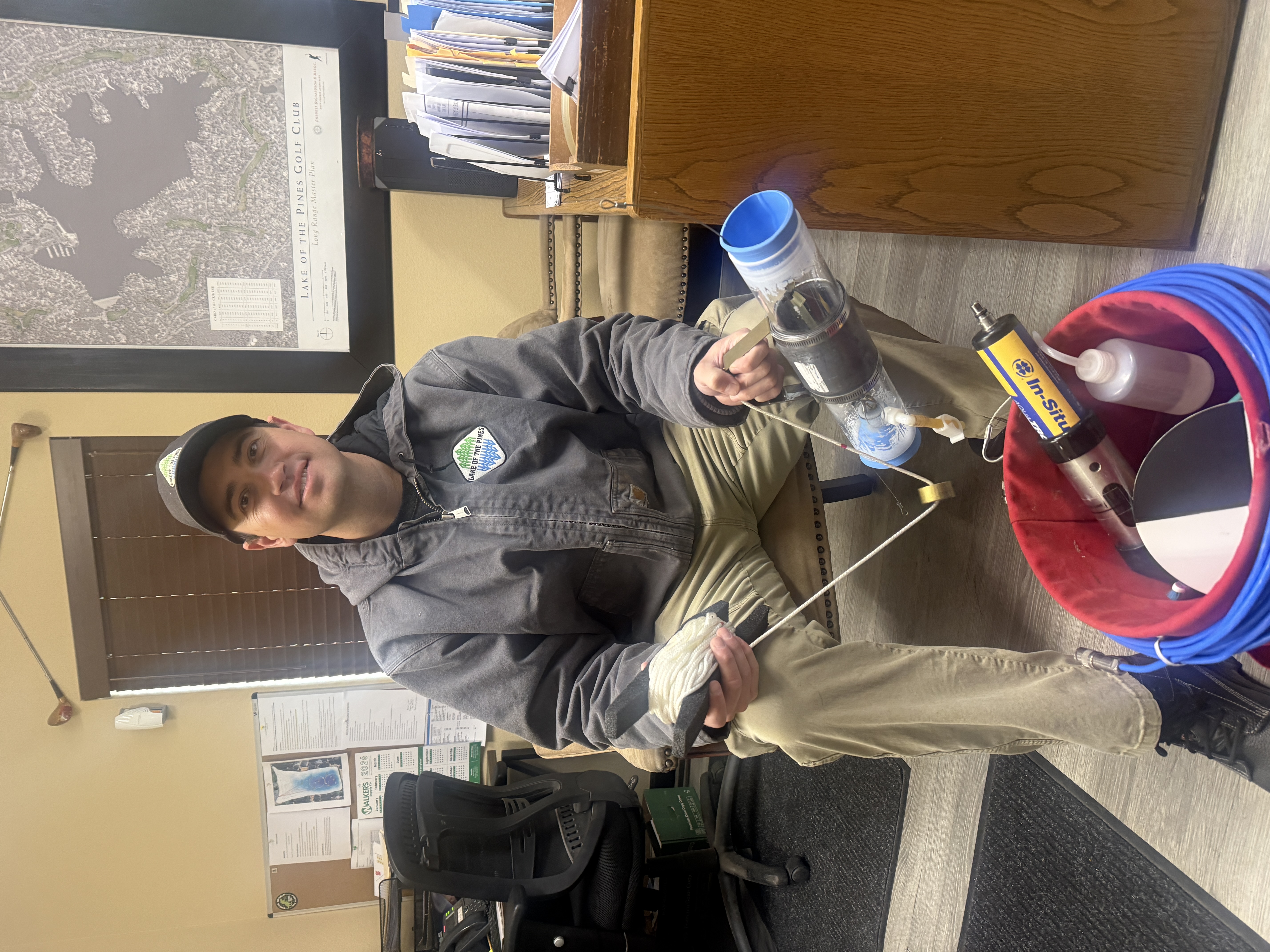
When we say "buoy in a box," we mean it. The system arrives with sensors pre-installed, telemetry configured, and your dashboard account provisioned. We fully test every unit before it leaves our facility to ensure it is ready for immediate deployment. Field setup typically takes a couple of hours: anchor the mooring, lower the buoy, confirm the cellular connection, and verify data is flowing to the platform.
While the system is designed for easy self-installation, LakeTech can also provide professional on-site installation services for an additional cost. We also recommend coordinating with our team on a cleaning and maintenance schedule before deployment. Biofouling rates, sediment loading, and algae growth vary significantly between aquatic ecosystems. A clear mountain reservoir might go six to eight weeks between cleanings, while a warm, eutrophic pond in the Southeast might need attention every two to three weeks. LakeTech helps you dial in the right cadence for your specific site so your data stays reliable.
For communities and organizations that want training on sensor maintenance and calibration, we offer hands-on sessions either on-site or remotely. Many of our customers handle routine maintenance independently after an initial training session, reaching out to LakeTech for calibration support or troubleshooting as needed.
- Pre-configured system fully tested before shipment
- Deploys in hours, not days
- Professional installation services available for an additional cost
- Cleaning schedule customized to your lake's ecosystem type
- On-site or remote training available for local maintenance teams
- LakeTech support available for calibration and troubleshooting
Is the Buoy in a Box Right for Your Lake?
The Buoy in a Box is built for lake managers, HOAs, water districts, environmental consultants, and research teams who need reliable continuous monitoring without a drawn-out procurement and installation process. If you manage a lake, reservoir, or pond and want to understand what is happening in your water column between site visits, this system was designed for you. For sites where the primary concern is dissolved oxygen stratification and budget is tighter, our top-and-bottom RDO sensor configuration is a leaner alternative that still provides the critical depth-resolved oxygen data needed to track hypolimnetic conditions. Not sure which setup fits your site? Reach out and we will walk through your lake's characteristics, management goals, and budget to recommend the right configuration.