
A Collaborative Morning on Oakland's Urban Lagoon
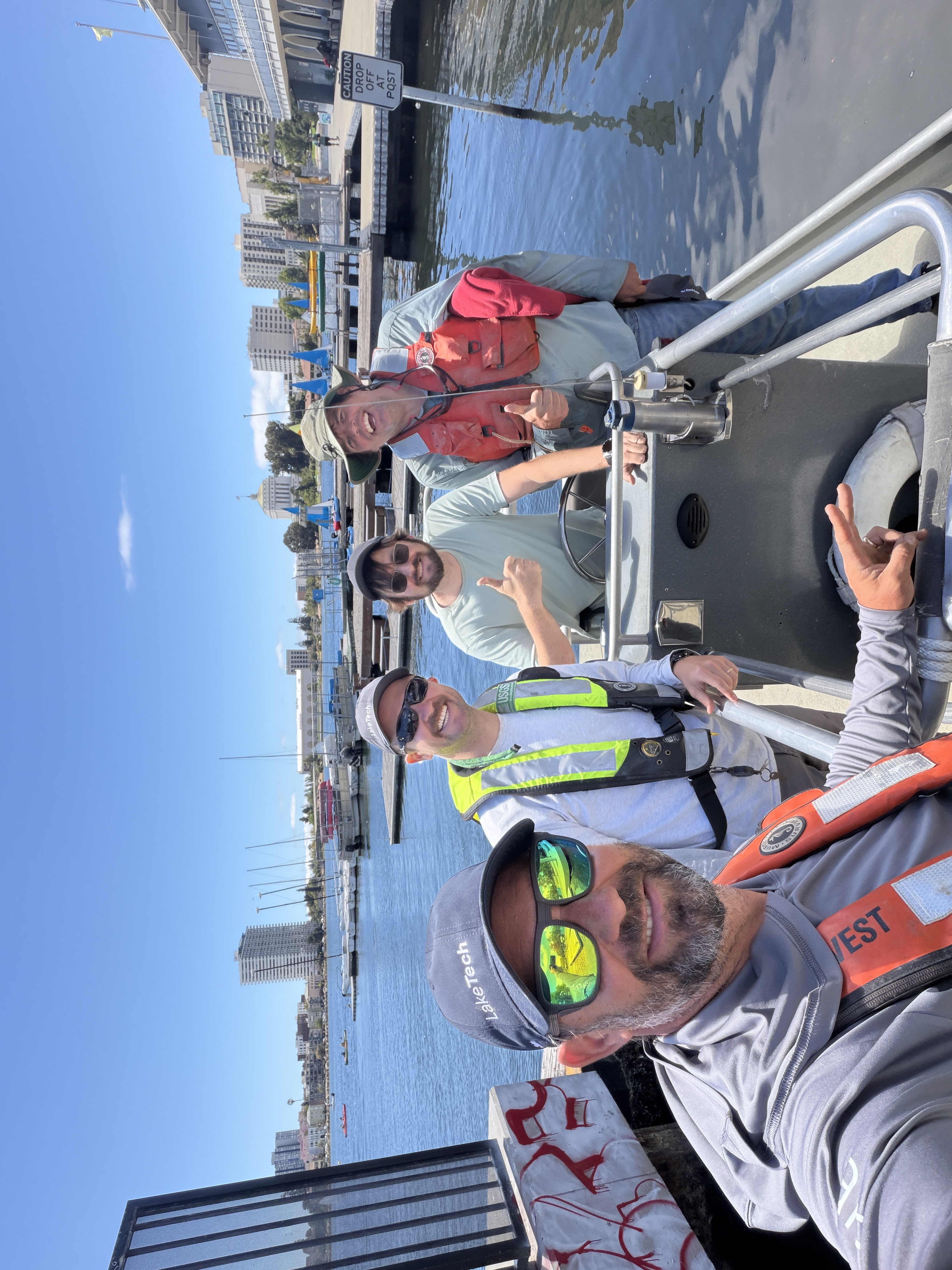
On July 22, 2026, LakeTech President Eli Kersh hit the water at Lake Merritt alongside field crews from the U.S. Geological Survey (USGS), the San Francisco Estuary Institute (SFEI), and the City of Oakland. The mission for the day was a meaningful one: deploying a Sea-Bird Scientific SUNA V2 nitrate sensor to bring continuous nutrient monitoring to the heart of downtown Oakland.
Lake Merritt is no ordinary waterbody. The tidal lagoon sits in the center of the city, exchanges water with San Francisco Bay, and holds the distinction of being named the first official wildlife refuge in the United States back in 1870. It is also a waterbody that has seen real stress, which makes reliable, high frequency water quality data all the more valuable.
Projects like this one work best when the right people are in the boat together. Federal science expertise from USGS, regional monitoring leadership from SFEI, local stewardship from the City of Oakland, and hands-on sensor deployment experience from LakeTech all came together on a single small workboat.
Why Nitrate Is the Number to Watch
Nitrate is one of the primary nutrients that fuels algal growth in lakes, lagoons, and estuaries. In an urban system like Lake Merritt, nitrogen arrives from many directions at once: stormwater runoff, landscape fertilizers, bird waste, and tidal exchange with the Bay. When nutrient concentrations climb, the risk of nuisance and harmful algal blooms climbs with them.
Bay Area residents remember the summer 2022 red tide that left thousands of dead fish along Lake Merritt's shoreline. Events like that unfold quickly, and monthly grab samples simply cannot capture the dynamics that drive them. A storm can flush a pulse of nutrients through the system in hours. Tidal cycles change conditions throughout the day.
Continuous monitoring closes that gap. A sensor that measures nitrate in place, around the clock, captures the spikes, the recoveries, and the patterns in between. That record gives scientists and managers the evidence they need to connect nutrient loading to bloom events and to evaluate whether management actions are working.
- Nitrate fuels algal productivity in nutrient sensitive systems
- Urban runoff and tidal exchange make Lake Merritt's nutrient picture especially dynamic
- Storm driven nutrient pulses can come and go between routine grab samples
- Continuous data connects nutrient loading to bloom events with real evidence
Inside the Sea-Bird Scientific SUNA V2
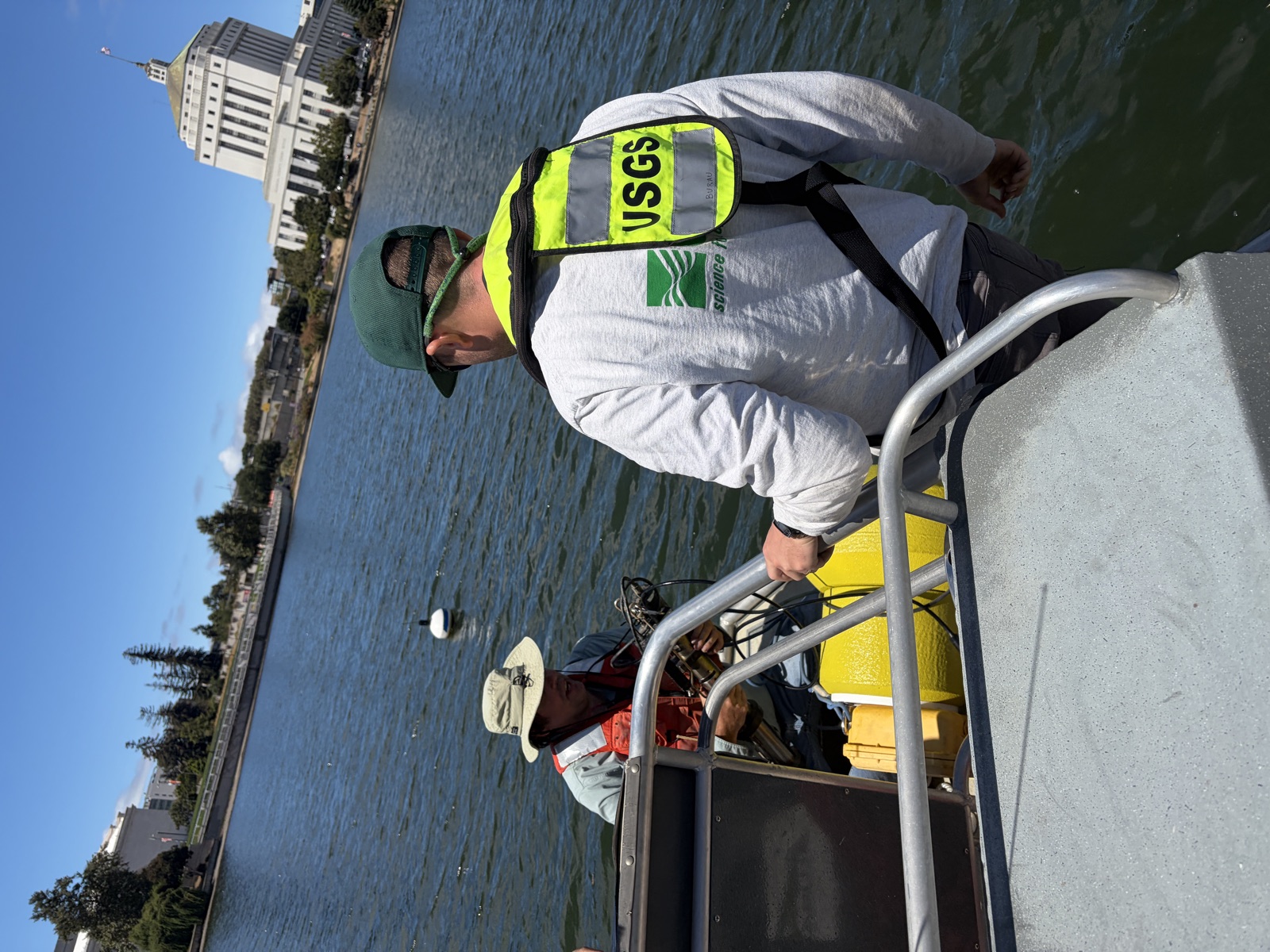
The SUNA V2 (Submersible Ultraviolet Nitrate Analyzer) is one of the most trusted nitrate sensors in aquatic science. Rather than relying on reagents or wet chemistry, it measures nitrate optically, using the absorption characteristics of nitrate in the ultraviolet light spectrum. A least squares fitting algorithm converts each UV absorption spectrum into a nitrate concentration in real time.
That optical approach is what makes the instrument practical for long deployments. There are no chemicals to replenish and no cartridges to swap. The sensor samples at up to once per second, logs to onboard memory, and communicates over standard protocols, which makes it straightforward to integrate into a buoy platform alongside other water quality instruments.
It is a serious piece of engineering built for serious environments, with the same core technology used from blue ocean research to storm runoff studies in rivers and streams. Bringing that capability to an urban lagoon in downtown Oakland says a lot about how much attention this waterbody is getting.
- Measures nitrate optically with UV absorption spectroscopy, no reagents required
- Samples at up to 1 Hz for true high frequency data
- Titanium housing with 2 GB of onboard data storage
- Integrates with monitoring platforms over SDI-12, RS-232, analog, and USB
- Optional biofouling protection for extended deployments
From Boat Deck to Buoy: The Deployment
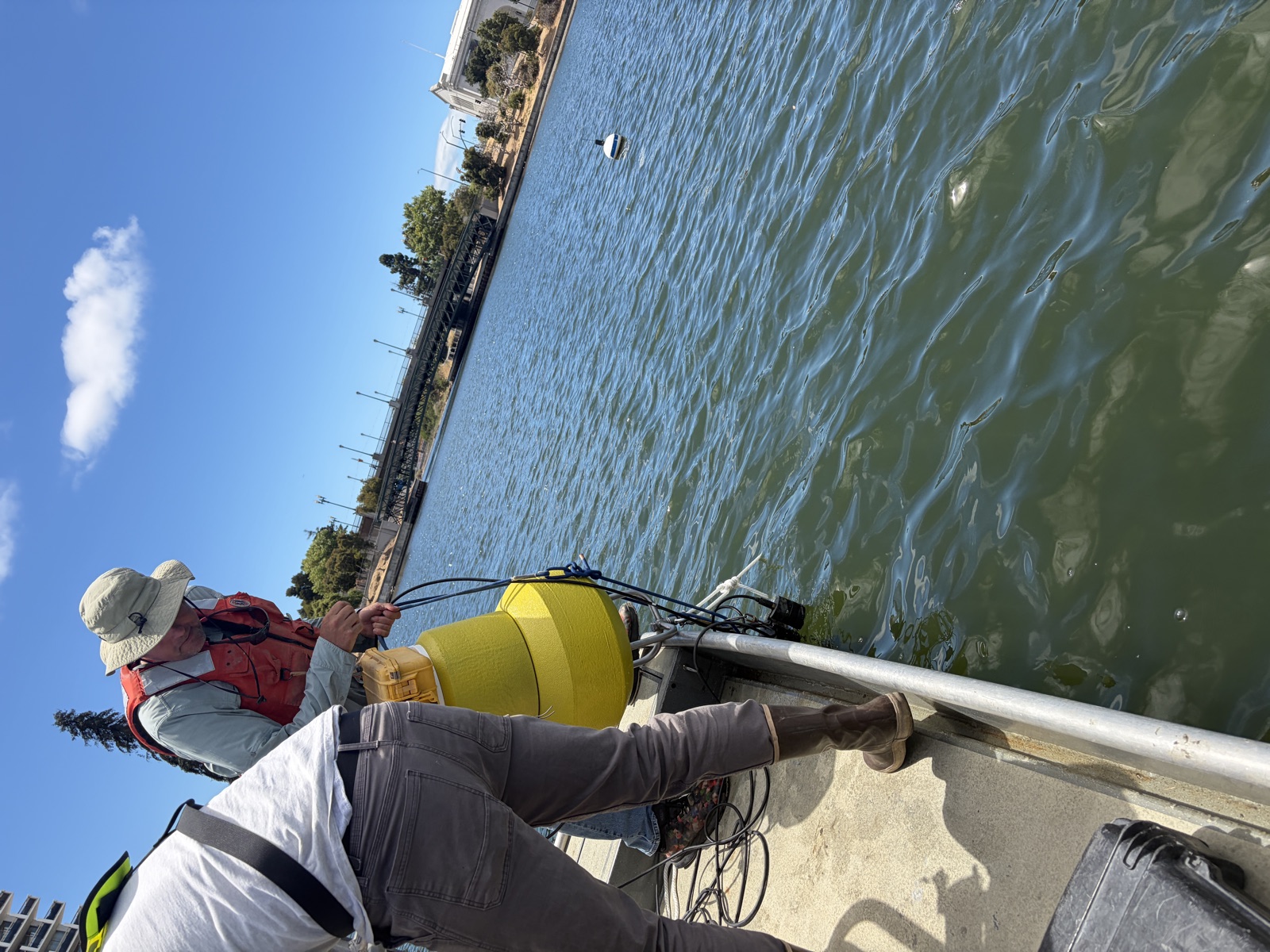
Deployment day is where planning meets salt water. The team staged the instrumented buoy on the workboat, ran through the cabling and mounting checks, and motored out to the monitoring site. With the platform positioned, the crew lowered the bright yellow buoy over the side and confirmed the sensor package was secure and communicating.
Small workboat deployments like this one demand coordination. One person manages the buoy's weight over the gunwale, another tends the sensor cables so nothing snags or kinks, and everyone keeps an eye on boat position. The whole evolution went smoothly, and the buoy settled onto station with downtown Oakland as its backdrop.
From here, the instrument goes to work. Every measurement it logs builds a continuous nitrate record for Lake Merritt that simply did not exist before.
What This Collaboration Means Going Forward
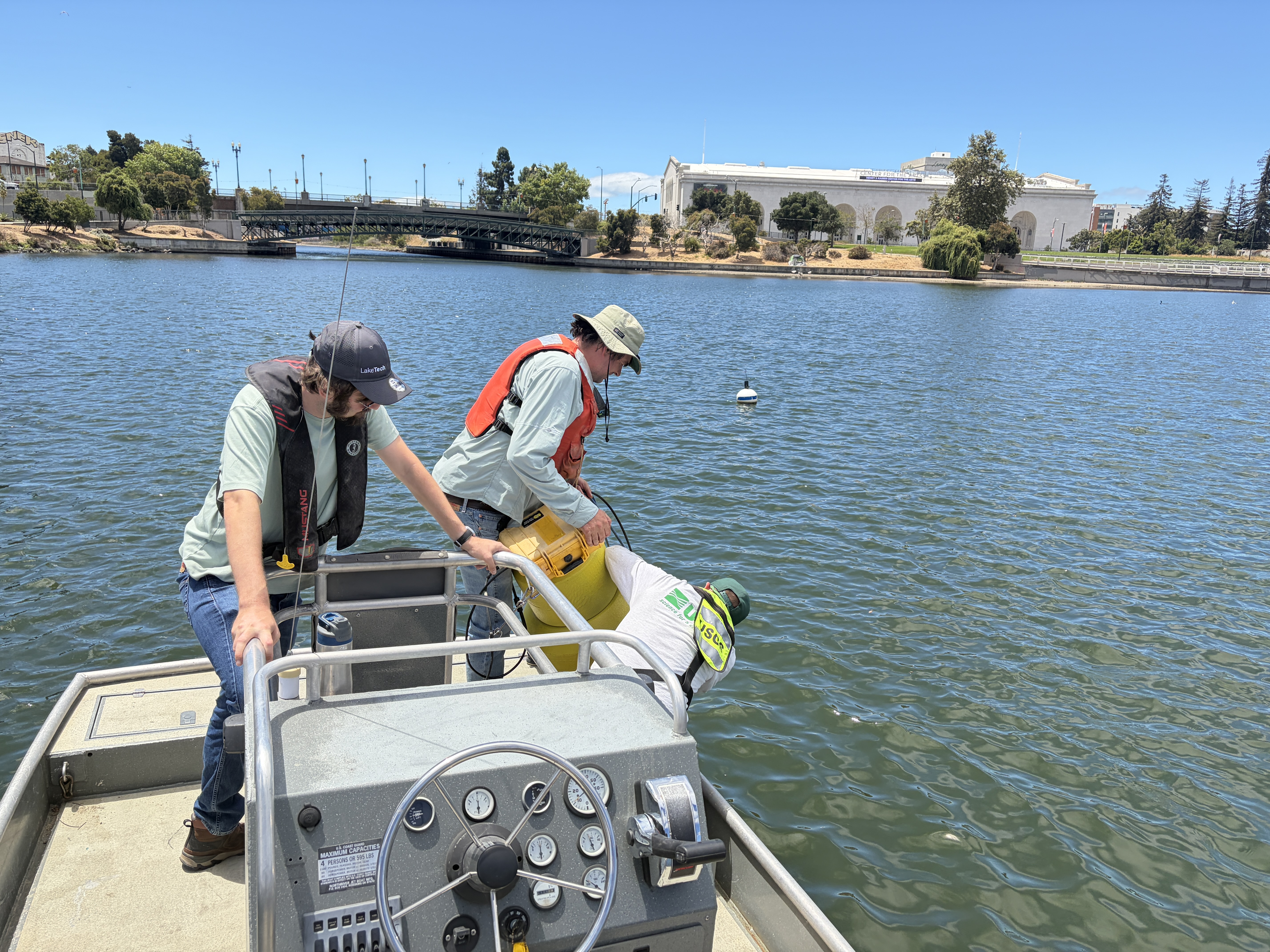
The best water quality outcomes happen when agencies, researchers, and industry work side by side. USGS brings decades of hydrologic monitoring rigor. SFEI anchors the regional science that puts Lake Merritt's data in the context of the entire San Francisco Estuary. The City of Oakland carries the local responsibility and the long term commitment to this waterbody. LakeTech is proud to contribute the field muscle and sensor platform expertise that turns good intentions into instruments in the water.
We see continuous nutrient monitoring becoming standard practice for urban waterbodies, not just flagship research sites. The technology is proven, the deployment playbook is well established, and the value of the data speaks for itself the first time a bloom event shows up in the record with the nutrient story attached.
If your lake, lagoon, or reservoir needs eyes on nutrients around the clock, our team can help you design the right monitoring platform, from single sensor deployments to fully instrumented buoys with telemetry.