
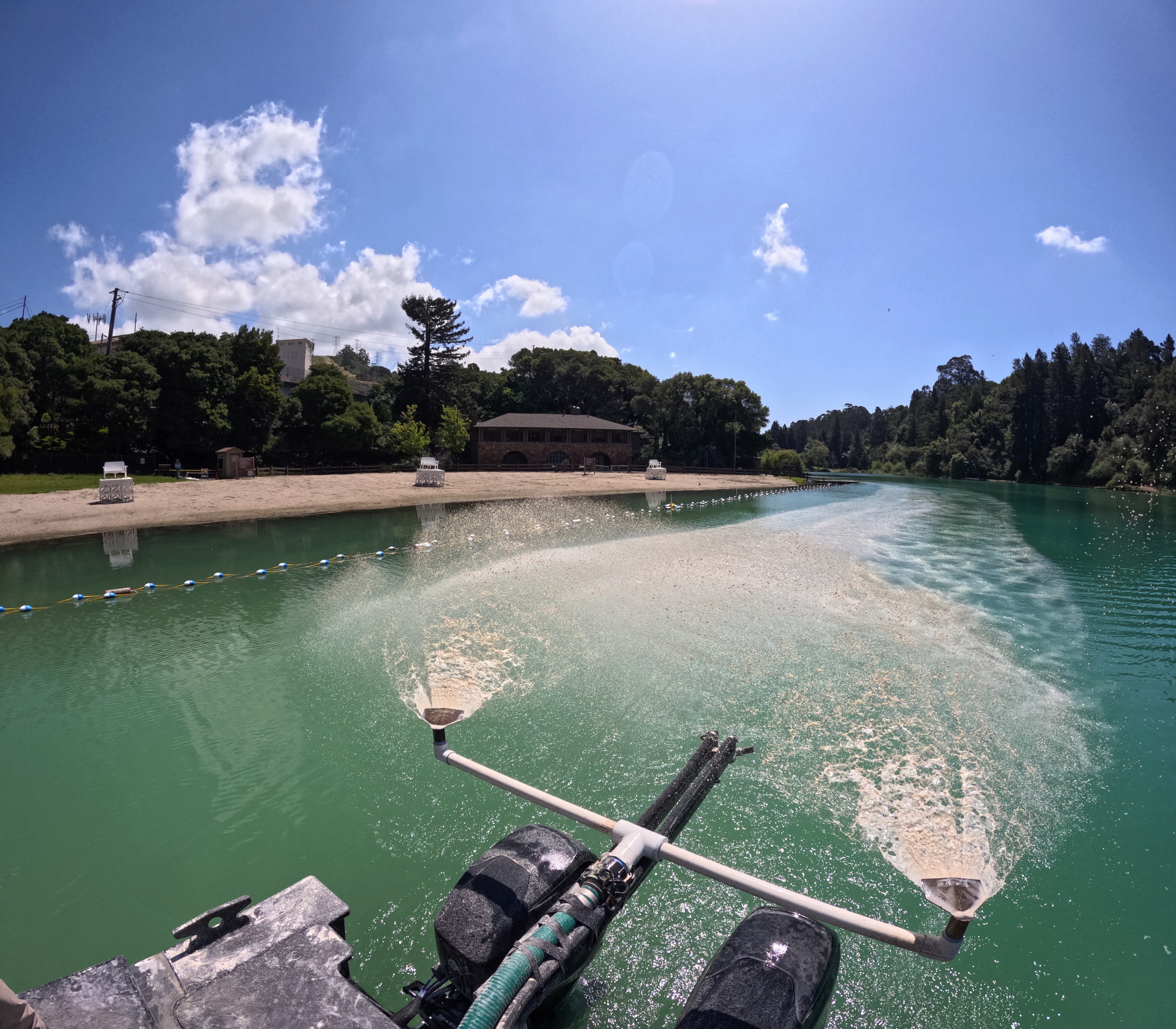
A Collaborative Water Quality Project at Lake Temescal
LakeTech is performing an aluminum chlorohydrate, or ACH, application at Lake Temescal in partnership with East Bay Regional Park District, the State Water Board, and USALCO. The project is focused on improving water quality in a shallow, eutrophic urban lake that has experienced harmful algal blooms, sedimentation, aquatic weeds, anoxia, and both internal and external nutrient loading.
Lake Temescal is a 9.6-acre lake in Oakland, California, with a long history of recreational use and water quality challenges. The lake is approximately 157 years old, with an average depth of 9.7 feet, making it polymictic, meaning it mixes frequently and can recirculate nutrients from the sediment into the water column. That internal nutrient cycling can help fuel algae and cyanobacteria growth when conditions are favorable.
- Project partners include LakeTech, East Bay Regional Park District, the State Water Board, and USALCO
- Lake Temescal has experienced harmful algal blooms since the 1970s
- The lake’s shallow, frequently mixing conditions make phosphorus control especially important
- The project combines nutrient sequestration with oxygenation and ongoing monitoring
Why ACH Was Selected Instead of Traditional Alum
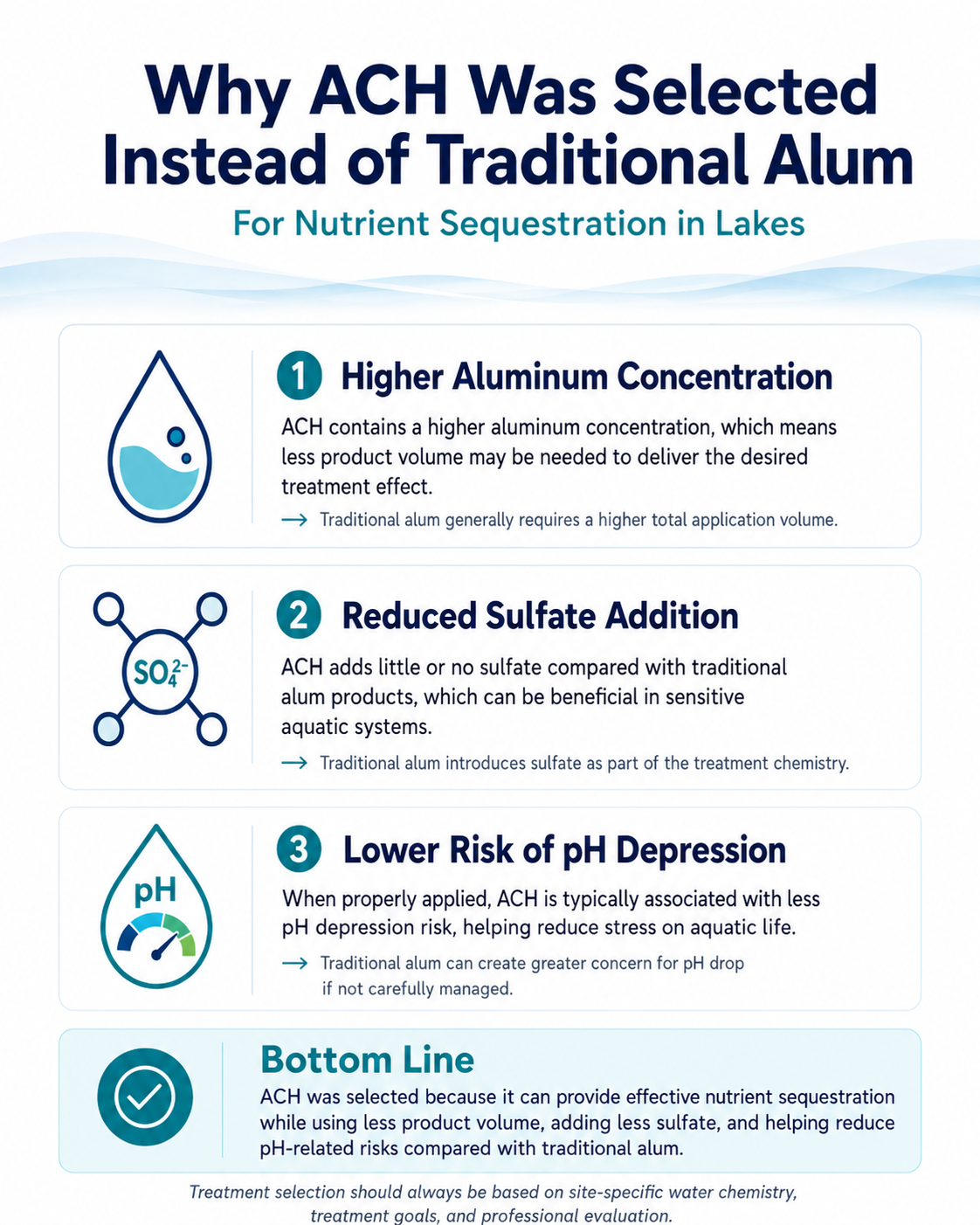
ACH is a proven nutrient sequestration chemistry used in wastewater treatment plants to bind phosphorus and reduce its availability for biological growth. In lake applications, the same principle is used to reduce soluble phosphorus in the water column and help limit phosphorus release from the sediment.
Traditional alum has been widely used for phosphorus control, but alum contains sulfate and can cause a sharper pH drop if not carefully dosed and buffered. Rapid pH changes can stress fish and other aquatic life, especially in sensitive systems. For this application, LakeTech is using ACH because it provides a higher aluminum concentration than alum, allowing the project team to apply less liquid volume while still achieving the target aluminum dose.
By using ACH, LakeTech can deliver an effective phosphorus-binding treatment with a reduced application volume and a lower risk of significant pH disruption when applied evenly across the lake.
- ACH is commonly used for nutrient sequestration in wastewater treatment
- ACH contains roughly three times the aluminum concentration of alum
- A higher aluminum concentration means less liquid volume is needed
- Reduced application volume helps support controlled, even treatment
- ACH avoids the sulfate load associated with alum
A Treatment Plan Built on Sediment Testing and Water Quality Monitoring
Before the application, the project team used sediment fractionation analysis and pre-treatment water quality data to calculate the treatment approach. Four sediment samples were analyzed in April 2025, and pre-treatment alkalinity was measured at 223 mg/L as CaCO₃ at 1 meter and 264 mg/L as CaCO₃ near the bottom.
The 2025 plan included phosphorus remediation using ACH and Phoslock, followed by installation of an Oxygen Saturation Technology system to address low hypolimnetic dissolved oxygen conditions. Monitoring was designed to evaluate treatment success at four lake locations, with samples collected at 1 meter and 0.5 meters above the bottom before treatment, one week after treatment, and again at 1, 2, 3, and 6 months after treatment.
- Four sediment samples were analyzed before treatment
- Sampling included surface and near-bottom water quality conditions
- Monitoring covered phosphorus, alkalinity, aluminum, dissolved aluminum, pH, oxygen, chlorophyll, phytoplankton, and microcystins
- The application used 3,000 gallons of ACH and 20,000 pounds of Phoslock
- ACH and Phoslock were applied on June 3 and June 4, 2025
- The oxygenation system was installed on June 9, 2025
Applying ACH and Phoslock Evenly Across the Lake
Even application is critical for any in-lake phosphorus remediation project. LakeTech applied ACH and Phoslock across Lake Temescal using specialized lake treatment equipment designed to distribute the material consistently through the target treatment area.
The goal was to bind available phosphorus, reduce internal phosphorus loading, and support better water clarity without causing a major pH disruption. During the application, pH was closely monitored with in-situ loggers and handheld multi-sensor probes at multiple depths.
The results showed that pH stayed within one pH unit of pre-treatment conditions, supporting one of the key reasons ACH was selected for this project.
- ACH and Phoslock were distributed across the lake treatment area
- pH was monitored during the application at multiple depths
- The application stayed within one pH unit of pre-treatment pH conditions
- Consistent application helped reduce the risk of localized treatment impacts
Early Results Show Lower Phosphorus and Reduced HAB Risk
Following treatment, total phosphorus levels declined and remained low through the September monitoring period. This is an important result because phosphorus is a primary nutrient driver for algal and cyanobacterial growth in eutrophic lakes.
The project also coincided with a major improvement in recreational water quality outcomes. Lake Temescal’s swim beach stayed open through the 2025 swim season without harmful algal bloom closures, and microcystin toxin levels were reduced compared with the elevated events documented in 2023 and 2024.
Because lake systems are complex, the project team is evaluating results carefully. The 2025 summer was unseasonably cool, which may have contributed to the outcome. Still, the combination of ACH, Phoslock, and oxygenation showed strong early promise for reducing phosphorus and mitigating cyanotoxin risk.
- Total phosphorus dropped after treatment and remained low through September
- Microcystin toxin levels were reduced in 2025
- The swim beach stayed open through the swim season without HAB closures
- Cooler seasonal weather may have contributed to the positive outcome
- Continued monitoring will help guide future treatment decisions
Oxygenation Supported Better Dissolved Oxygen Conditions
In addition to nutrient sequestration, LakeTech installed an Oxygen Saturation Technology system to help mitigate low dissolved oxygen conditions near the lake bottom. Low oxygen can contribute to internal phosphorus release from sediments, which can then feed additional algae and cyanobacteria growth.
The oxygenation system was installed on June 9, 2025, shortly after the ACH and Phoslock application. Monitoring results showed that the system helped create the desired oxygen levels in Lake Temescal, supporting the broader goal of reducing internal nutrient loading and improving habitat conditions.
- Low dissolved oxygen can increase phosphorus release from lake sediments
- Oxygenation helps support healthier bottom-water conditions
- The OST system was installed shortly after the nutrient sequestration treatment
- Improved oxygen conditions complemented the ACH and Phoslock application
Lessons Learned and Next Steps
The Lake Temescal project demonstrates how ACH can be a strong alternative to alum for lake phosphorus management when it is dosed correctly, applied evenly, and paired with monitoring. Early results indicate that ACH and Phoslock, combined with oxygenation, can reduce phosphorus and help mitigate cyanotoxin risk.
The project also showed that improving water clarity can create new management needs. As light penetration increases, aquatic weeds may expand and require additional intervention. For 2026, the project team plans to repeat and refine the approach while continuing to acknowledge that lake response can vary year to year.
- ACH showed little impact on pH when applied evenly across the lake
- ACH and Phoslock appear effective for reducing phosphorus
- Oxygenation helped improve dissolved oxygen conditions
- Clearer water may increase aquatic weed growth
- Continued adaptive management will guide the 2026 plan