
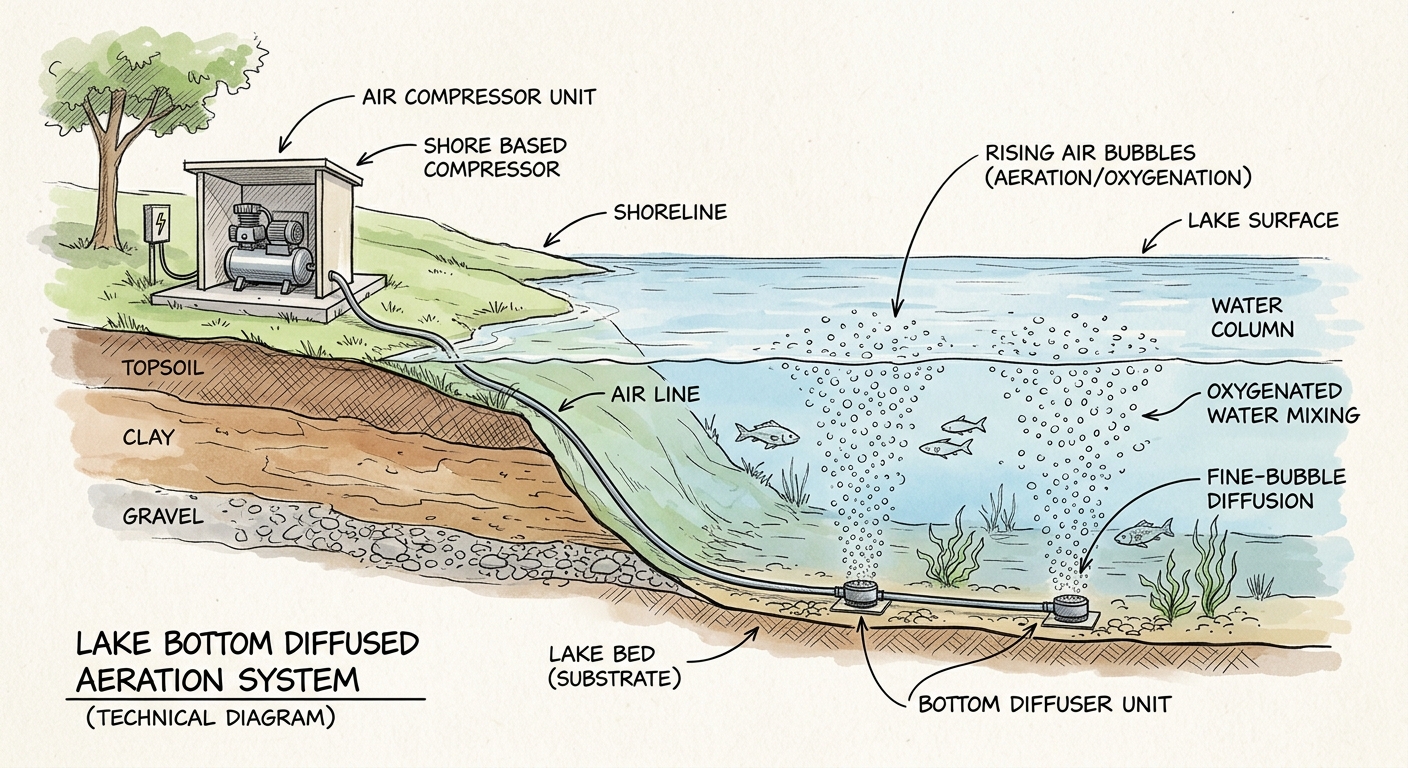
How diffused aeration works
A diffused aeration system has three core components: a compressor housed on shore, weighted airline tubing running along the lake bottom, and one or more diffuser assemblies positioned at the deepest points. The compressor pushes air through the tubing to the diffusers, which release fine bubbles that rise to the surface.
As bubbles rise, they create a vertical current that lifts oxygen-depleted bottom water to the surface where it can absorb atmospheric oxygen. This circulation pattern, called destratification, eliminates the stagnant bottom layer that drives phosphorus release and algae growth. The result is a uniformly oxygenated water column from surface to sediment.
- Fine-bubble diffusers produce smaller bubbles that rise more slowly, maximizing oxygen transfer efficiency
- Each diffuser station creates a circulation cell that can mix 1-3 acres depending on depth and compressor output
- The destratification effect is often more valuable than the direct oxygen added by the bubbles themselves
Sizing compressors and diffuser stations
The two key sizing factors are lake depth and volume. Deeper lakes need compressors rated for higher pressure to push air to the bottom, typically 3-5 PSI for lakes in the 15-30 foot depth range. Volume determines how many diffuser stations you need, since each station effectively circulates a finite area.
A common starting point is one diffuser station per 1-2 surface acres in lakes 8-15 feet deep, and one per 2-3 acres in lakes deeper than 15 feet where the longer bubble column creates stronger circulation. Compressor capacity should deliver 2-4 CFM (cubic feet per minute) of air per diffuser station for adequate mixing.
- Rocking-piston compressors are the standard for lakes under 50 feet, reliable, rebuildable, and energy-efficient
- Rotary-vane compressors suit very deep applications (50+ feet) where higher pressure is needed
- Plan airline runs to minimize total tubing length, long runs create friction losses that reduce air delivery
Installation and long-term maintenance
Diffuser plates are typically sunk to the bottom by boat, with weighted airline tubing laid along the lakebed back to shore. The compressor is installed in a ventilated cabinet or small shed near the shoreline, connected to a dedicated electrical circuit. Most installations are completed in one day for systems with up to four diffuser stations.
Maintenance requirements are modest but important. Compressor air filters should be checked monthly and replaced as needed. Rebuild kits for rocking-piston compressors are typically needed every 3-5 years and cost a fraction of a new compressor. Diffuser membranes should be inspected annually and replaced if bubble output becomes uneven, which usually happens every 3-5 years depending on water conditions.
- Mount the compressor above the flood line and ensure the cabinet has adequate ventilation to prevent overheating
- Install a check valve at each diffuser to prevent water from back-siphoning into the airline when the compressor stops
- Keep a spare air filter and rebuild kit on hand to minimize downtime during the critical summer months