
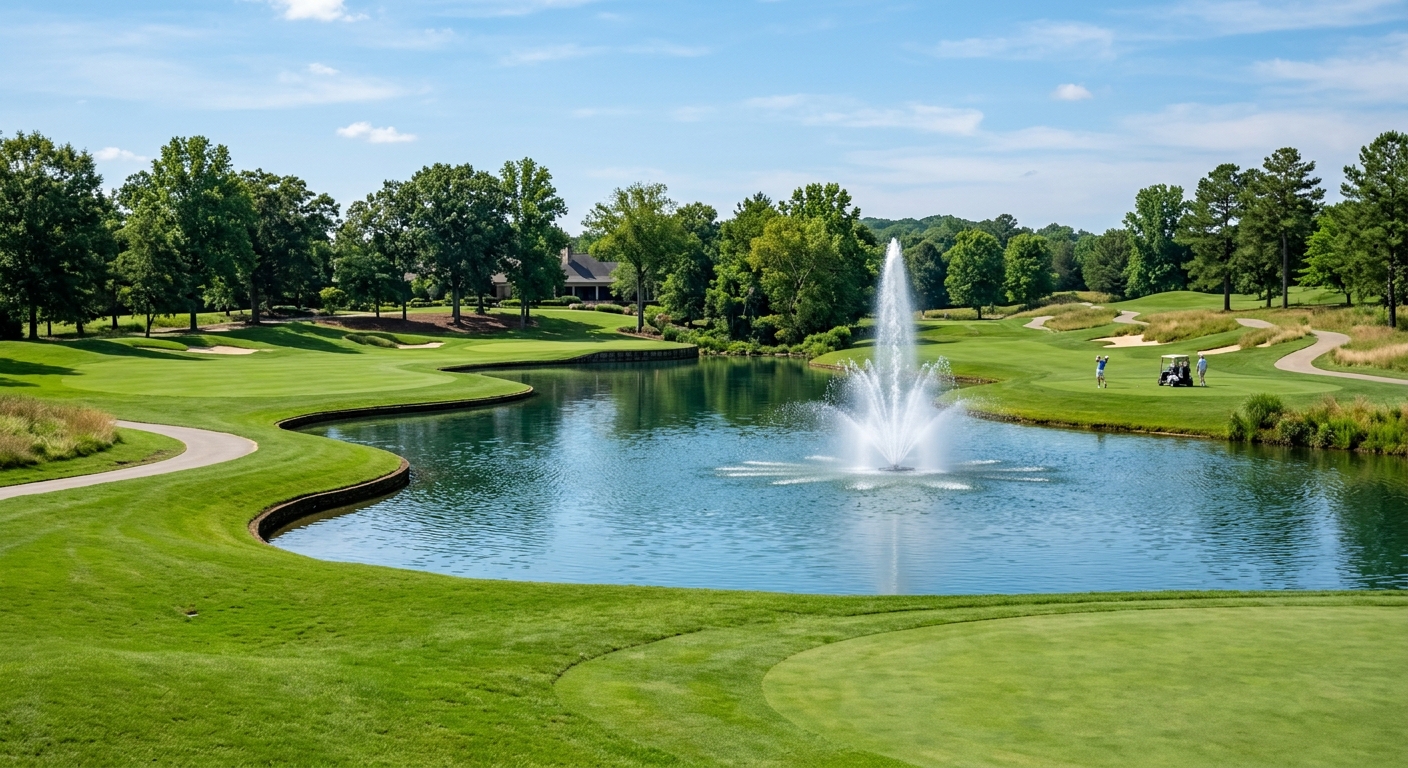
Why golf course ponds are different
Golf courses apply significant amounts of fertilizer to maintain playing surfaces, and a portion of that fertilizer inevitably moves into nearby ponds through surface runoff and subsurface drainage. Nitrogen and phosphorus, the nutrients that drive turf growth, are the same nutrients that drive algae growth in standing water. This means golf course ponds receive a constant supply of the inputs that cause water quality problems.
Many of these ponds also serve as irrigation reservoirs. The course pulls water from them to irrigate fairways and greens, which means water quality directly affects turf health. High-nutrient water can contribute to disease pressure on turf, clog irrigation filters, and create uneven application if algae or sediment is being pumped through the system.
On top of the functional demands, golf course ponds are visual features. They appear in course photography, tournament broadcasts, and marketing materials. Members and guests notice when a pond is covered in algae or surrounded by eroded banks. The aesthetic standard for a golf course pond is higher than for a stormwater basin behind a strip mall, and the management program needs to reflect that.
- Turf fertilizer runoff delivers a steady supply of nitrogen and phosphorus, the primary drivers of algae growth.
- Many course ponds double as irrigation reservoirs, making water quality a turf management issue.
- Ponds are visual features of the course and are held to a higher aesthetic standard than typical retention ponds.
Common water quality issues on golf courses
Algae is the most visible and persistent problem. The nutrient loading from fertilizer applications creates ideal conditions for algae growth, especially during the warm season when both fertilizer use and biological activity are at their peak. Without active management, algae blooms can appear within days of a fertilizer application event followed by rain.
Organic muck accumulation is the longer-term issue. Grass clippings, leaf debris from surrounding trees, dead algae, and organic sediment from turf runoff all settle to the bottom of course ponds. Over years, this organic layer thickens, reduces pond depth, and creates anaerobic conditions at the bottom that produce hydrogen sulfide, the rotten-egg smell that occasionally drifts across nearby holes.
Water clarity and color matter more on a golf course than in most other settings. Even mild turbidity or a greenish tint can draw complaints from members and affect the visual quality of the course. Managing clarity requires controlling both the algae in the water column and the nutrient cycle that feeds it, which means addressing inputs from the surrounding turf as well as conditions within the pond itself.
- Algae blooms that can appear within days of fertilizer applications followed by rainfall.
- Organic muck buildup from grass clippings, tree debris, and dead algae that reduces pond depth over time.
- Water clarity and color issues that affect the visual quality of the course and draw member complaints.
How LakeTech works with courses and superintendents
LakeTech works directly with the golf course superintendent and grounds team because they understand the course's operations, irrigation schedule, and fertilizer program better than anyone. That relationship is essential, effective pond management on a golf course requires coordination with turf management, not separation from it.
The management program typically includes regular water quality monitoring keyed to the course's fertilizer application schedule, biological treatment to manage nutrient levels and algae, and sediment management to prevent long-term muck accumulation. LakeTech also evaluates whether aeration would benefit specific ponds based on their depth, shape, and how heavily they are loaded with nutrients.
For courses that use ponds as irrigation sources, LakeTech monitors the parameters that affect irrigation quality, including pH, conductivity, and biological oxygen demand, so the superintendent has data to work with when making irrigation decisions. The goal is to keep the ponds healthy enough to serve their dual role as both water features and functional infrastructure.
- Direct coordination with the superintendent and grounds team to align pond management with turf operations.
- Water quality monitoring scheduled around the course's fertilizer application cycle.
- Irrigation-quality monitoring for ponds that serve as water sources for fairways and greens.