
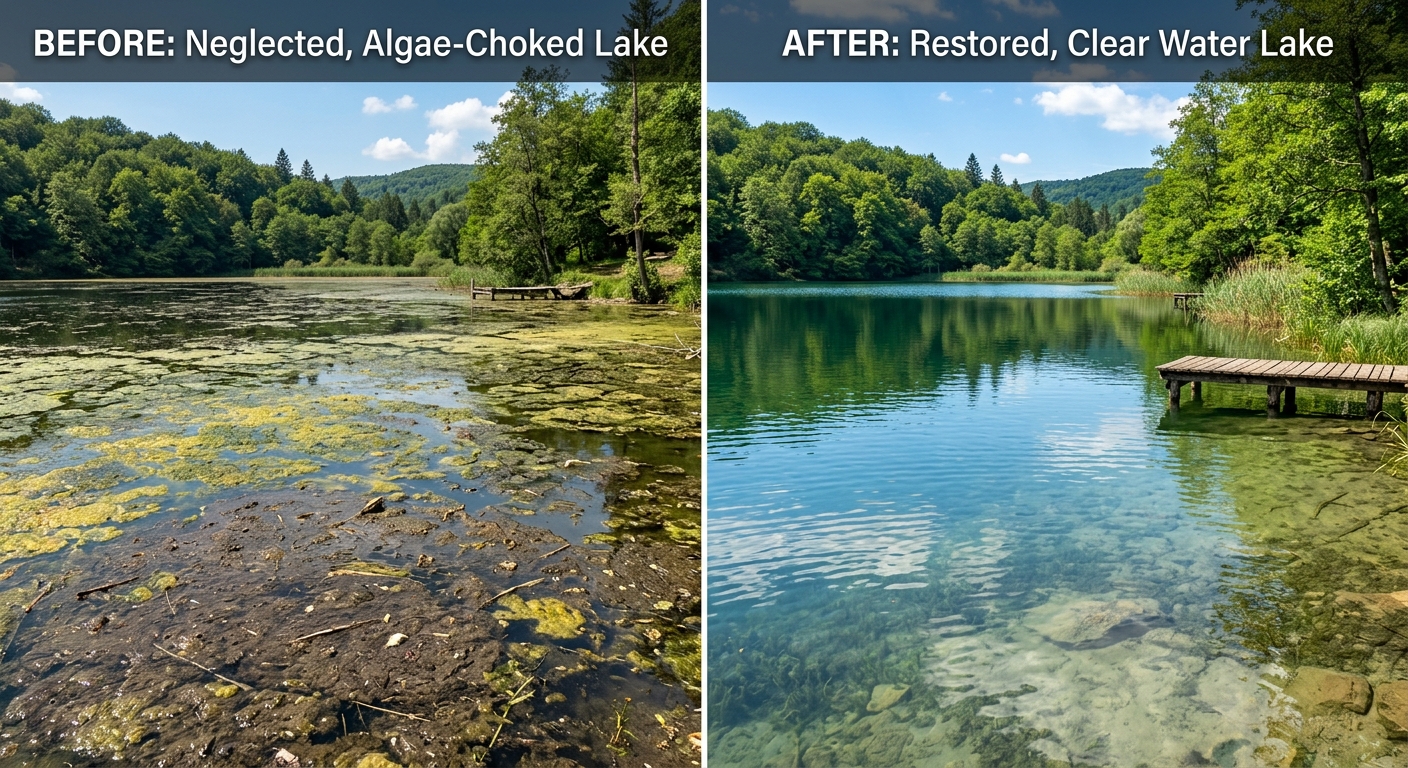
Urban lakes and reservoir systems
Southern California has relatively few natural lakes. Most of the region's waterbodies are man-made: reservoirs built for water supply, flood control, or recreation, and smaller lakes constructed as park amenities or community features. These artificial waterbodies tend to be shallower than natural lakes and are often designed with limited consideration for long-term water quality management.
The region's major reservoir systems, including those managed by the Metropolitan Water District, store imported water from the Colorado River and the State Water Project (Northern California). These reservoirs experience significant evaporative losses and water level fluctuations that affect shoreline habitat and nutrient cycling. Smaller urban lakes in parks and HOA communities are typically fed by a combination of urban runoff, recycled water, and supplemental potable water.
Imported water itself introduces management variables. Colorado River water, for example, tends to be harder and more mineral-rich than State Water Project deliveries, affecting water chemistry and treatment approaches in downstream waterbodies.
- Most Southern California lakes are man-made and tend to be shallow with limited natural buffering.
- Imported water from the Colorado River and State Water Project affects local water chemistry.
- HOA community lakes are often supplemented with potable or recycled water to maintain levels.
- Evaporative losses of 60+ inches per year are common in inland Southern California areas.
Year-round warmth and extended algae seasons
Unlike Northern California, where cold winters provide a natural reset for biological activity, Southern California's mild winters mean that algae can grow in many waterbodies nearly year-round. Water temperatures in inland areas rarely drop below 50°F even in January, which means there is no extended dormant period for biological processes.
This extended growing season has both advantages and drawbacks for management. Biological treatments like beneficial bacteria remain active longer, allowing for extended treatment windows. However, it also means that algae and cyanobacteria have more growing days per year, and nutrient cycling in bottom sediments continues through winter months rather than slowing down as it does in colder climates.
Summer water temperatures in inland Southern California routinely exceed 80°F, which accelerates oxygen consumption by decomposing organic matter and can push dissolved oxygen levels dangerously low, particularly in shallow waterbodies without supplemental aeration.
- Water temperatures in inland areas often stay above 50°F year-round, sustaining continuous biological activity.
- Summer surface temperatures can exceed 80°F, accelerating decomposition and oxygen demand.
- Beneficial bacteria treatments can be applied over a longer season than in Northern California.
- Aeration is especially critical in summer when warm water holds less dissolved oxygen.
Regional Water Board oversight in Southern California
Southern California falls under the jurisdiction of several Regional Water Quality Control Boards. The Los Angeles Regional Board (Region 4) covers LA County and Ventura County. The Santa Ana Regional Board (Region 8) covers Riverside, San Bernardino, and Orange Counties. The San Diego Regional Board (Region 9) covers San Diego and parts of southwestern Riverside County.
Urban stormwater regulations are particularly relevant in Southern California, where the MS4 (Municipal Separate Storm Sewer System) permits impose strict limits on pollutant discharges from developed areas. Ponds and lakes that receive stormwater runoff or discharge to the storm drain system may be subject to monitoring and reporting requirements under these permits.
Several Southern California waterbodies have nutrient-related TMDLs. Lake Elsinore, for example, has TMDLs for nutrients and sediment. Property owners and managers near listed waterbodies should understand the applicable load allocations and how their management activities interact with compliance requirements.
- The LA Regional Board (Region 4) and Santa Ana Regional Board (Region 8) cover most of the greater LA metro area.
- MS4 stormwater permits may impose monitoring requirements on waterbodies receiving urban runoff.
- Lake Elsinore has TMDLs for nutrients and sediment that affect surrounding land uses.
- The San Diego Regional Board (Region 9) covers San Diego County and southwestern Riverside County.