
Skip to content
Lake and pond expertiseSoftware, monitoring, and consulting
LakeTech homeEducationLake & Pond Problems Guide
Overview

Lake & Pond Problems Guide

Most lake and pond issues trace back to a handful of root causes: excess nutrients, organic sediment accumulation, and poor oxygen circulation. Understanding which problem you are dealing with is the first step toward choosing a response that actually works.

LakeTech distributes water treatment products including MuckBiotics and Metafloc. These pages explain common lake and pond problems so owners can make informed decisions about whether professional treatment programs fit their situation.

Articles

Explore Lake & Pond Care topics

Gloved hand lowering a black and white Secchi disk into green lake water beside a boat
Lake & Pond Care

Lake Algae Bloom Control: What Works and What Doesn't

Why algae blooms happen in lakes, what feeds them, and the realistic options for controlling them, from nutrient management to biological and chemical treatments.

Read more →
Natural pond with water lilies in bloom and a densely vegetated forest shoreline
Lake & Pond Care

Pond Algae Control: A Practical Guide for Pond Owners

Why your pond turns green and what you can realistically do about it. Covers nutrient management, aeration, biological treatments, and when algaecides make sense.

Read more →
Golf course pond with a spray fountain running beside a fairway
Lake & Pond Care

Aquatic Weed Control: Managing Unwanted Plant Growth in Lakes and Ponds

Why aquatic weed growth becomes a problem in lakes and ponds, how observation and identification support management decisions, and what to verify with authorities before acting.

Read more →
Aerial view of a neighborhood lake bordered by homes, a dock, and a walking path
Lake & Pond Care

Duckweed Control: Why It Takes Over and How to Manage It

Duckweed can cover a pond surface in days. Learn what drives duckweed overgrowth, why it keeps coming back, and the practical options for controlling it.

Read more →
City park lake with people walking a shoreline path and small boats on the water
Lake & Pond Care

Muck Reduction and Removal: Dealing With Bottom Sediment Buildup

Understand what causes muck buildup in lakes and ponds, and compare the realistic options for reducing it, from biological treatment and aeration to dredging.

Read more →
Split-screen illustration comparing an algae covered pond bottom with a clear pond after treatment
Lake & Pond Care

Fish Kill Prevention: Understanding Why Fish Die and How to Protect Them

Understand the common causes of fish kills in lakes and ponds, low oxygen, temperature swings, algae die-offs, and what you can do to prevent them.

Read more →
Gloved hand lowering a black and white Secchi disk into green lake water beside a boat
Lake & Pond Care

Low Dissolved Oxygen in Lakes: Causes, Consequences, and Solutions

Why dissolved oxygen drops in lakes and ponds, what it means for fish and water quality, and the practical steps to improve oxygen levels in your waterbody.

Read more →
Natural pond with water lilies in bloom and a densely vegetated forest shoreline
Lake & Pond Care

Lake Odor Problems: Why Your Lake Smells and What You Can Do

Understand why lakes and ponds develop bad odors, from rotten egg smells to musty and fishy scents, and learn the practical options for reducing them.

Read more →
Golf course pond with a spray fountain running beside a fairway
Lake & Pond Care

Murky and Turbid Lake Water: Why You Can't See the Bottom

Why lake and pond water turns murky or cloudy, the difference between algae turbidity and sediment turbidity, and what actually works to improve water clarity.

Read more →
Aerial view of a neighborhood lake bordered by homes, a dock, and a walking path
Lake & Pond Care

Nutrient Loading in Lakes: Where the Phosphorus and Nitrogen Come From

Learn how to inventory, measure, and compare external and internal phosphorus and nitrogen loads without assuming a source from land use, proximity, or one sample.

Read more →
City park lake with people walking a shoreline path and small boats on the water
Lake & Pond Care

Eutrophication Management: Understanding Nutrient Enrichment

What eutrophication is, why it happens faster in some lakes, and the management strategies that can slow or partially reverse the process of nutrient enrichment.

Read more →
Split-screen illustration comparing an algae covered pond bottom with a clear pond after treatment
Lake & Pond Care

Shoreline Erosion Around Lakes: Causes and Stabilization Options

Why lake shorelines erode, what accelerates the problem, and the practical options for stabilizing your shoreline, from native plantings to engineered solutions.

Read more →
Gloved hand lowering a black and white Secchi disk into green lake water beside a boat
Lake & Pond Care

Harmful Algal Bloom Monitoring: Protecting People and Pets

How to observe, report, sample, and respond to a suspected freshwater harmful algal bloom without confusing appearance, pigments, organism identity, or toxin results.

Read more →

Why lake and pond problems cluster together
Split-screen illustration comparing an algae covered pond bottom with a clear pond after treatment

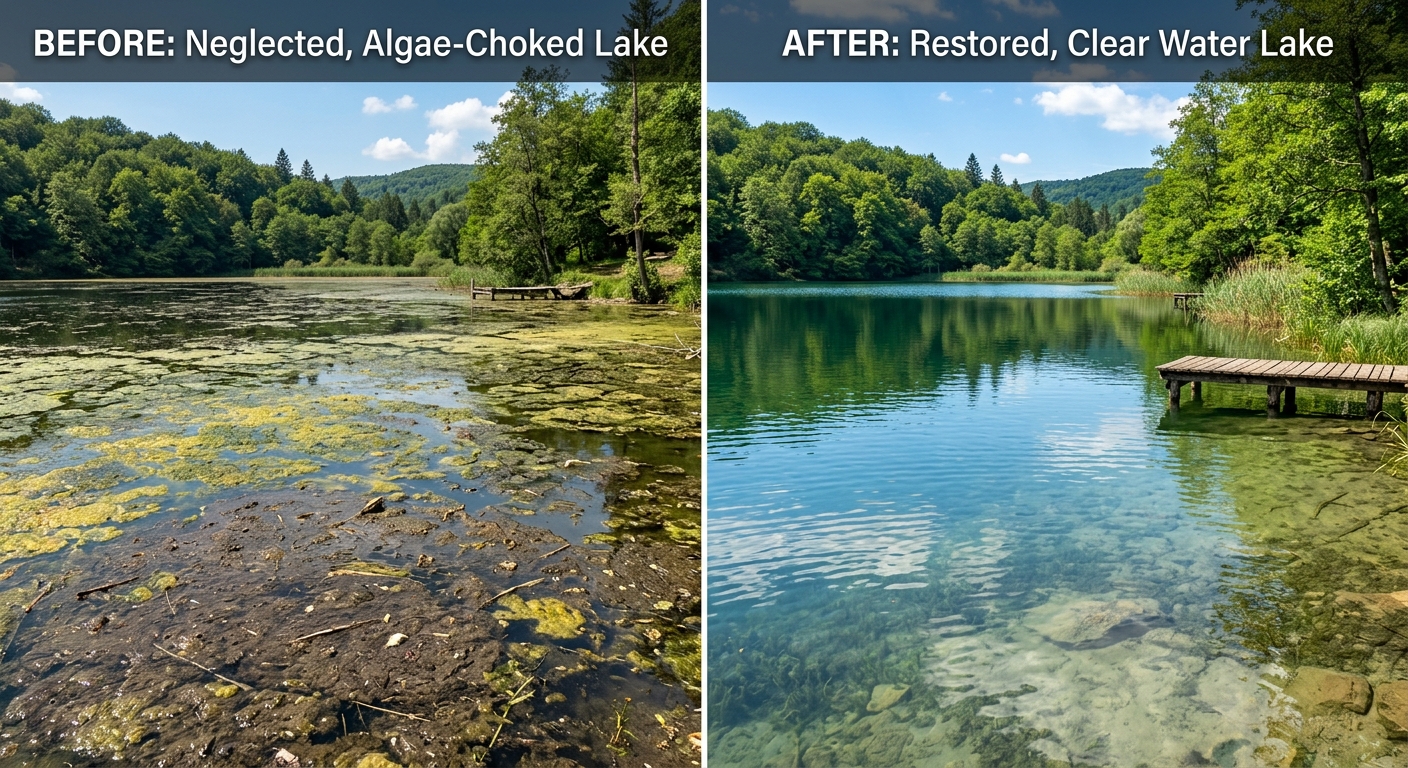
If you own or manage a lake or pond, you have probably noticed that problems rarely show up alone. Algae blooms follow nutrient runoff. Muck accumulates where organic matter settles faster than it breaks down. Low oxygen leads to fish stress, odor, and more muck. These issues are connected, and understanding the chain helps you avoid chasing symptoms while the root cause persists.

This guide covers thirteen of the most common problems lake and pond owners face. Each page explains what causes the issue, what makes it worse, and what realistic options exist for managing it. Some problems respond well to biological treatment. Others require mechanical intervention, aeration, or changes to the surrounding watershed. We try to be honest about which is which.

  • Algae blooms, pond scum, and harmful algal blooms
  • Aquatic weed and duckweed overgrowth
  • Muck accumulation and bottom sediment buildup
  • Fish kills, low dissolved oxygen, and poor water clarity
  • Nutrient loading, eutrophication, and shoreline erosion
  • Persistent odor coming from the water or shoreline

How to use these pages

Start with the problem you are actually seeing. If your lake smells bad, read the odor page. If you are losing fish, check the dissolved oxygen and fish kill pages. Each page explains the likely causes and walks through the options, including when professional help makes sense and when simpler steps might be enough.

These pages are written for property owners, HOA boards, lake association members, and anyone else responsible for a body of water they care about. We try to avoid jargon, but where technical terms are necessary we explain what they mean in practical terms.

  • Each page covers one problem in detail with causes and options
  • Cross-links connect related problems so you can trace the chain
  • Product-specific pages are linked where a treatment option is relevant
  • No signup or download required: all content is free to read
FAQ

Frequently asked questions

My lake has multiple problems at once, where do I start?

Start with dissolved oxygen if fish are stressed or dying. Otherwise, start with whatever is most visible or most urgent. The pages cross-link to related issues, so you will naturally find the connected problems as you read.

Can I fix these problems myself or do I need a professional?

It depends on the problem and the size of your waterbody. Small ponds with mild muck or algae issues can often be managed by the owner. Larger lakes, persistent harmful algal blooms, or fish kills usually benefit from professional assessment. Each page gives guidance on when professional help is worth it.

Ready to get started?

Start planning your Lake & Pond Care project today

Describe your situation and get honest guidance on whether a treatment program makes sense for your waterbody.

Talk to LakeTech about your lake or pond