
Why shorelines erode
Some shoreline erosion is natural, waves, current, ice, and weather have always reshaped lake edges. But human activities often accelerate erosion far beyond natural rates. Removing native shoreline vegetation to create lawns or beaches eliminates the root systems that hold soil in place. Increased boat traffic creates wakes that pound the shore repeatedly. Impervious surfaces in the watershed increase runoff volume and velocity. And fluctuating water levels, whether from dam operations, drought, or climate variability, repeatedly expose and submerge the shoreline, weakening the soil.
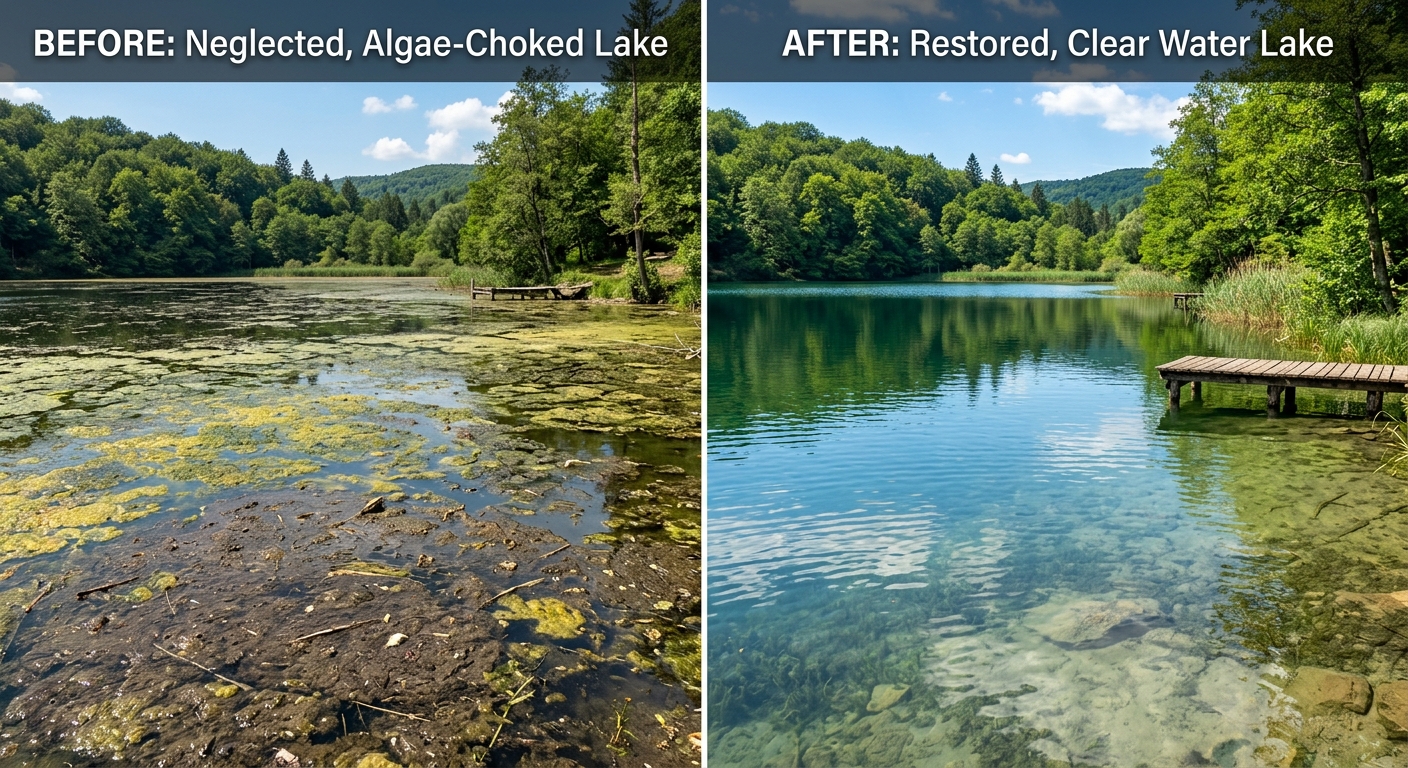
Muck accumulation and poor water quality can also contribute to erosion indirectly. When shoreline vegetation cannot establish because the water edge is too soft or nutrient-loaded, the natural stabilization that plants provide is lost. In some lakes, sediment washed in from eroding shorelines adds to the nutrient load, creating yet another feedback loop where erosion worsens water quality and poor water quality makes erosion harder to address.
- Removing native vegetation eliminates the root systems that hold shoreline soil
- Boat wakes create repeated wave impact that accelerates erosion
- Impervious surfaces increase runoff velocity hitting the shoreline
- Fluctuating water levels repeatedly weaken exposed soil
Stabilization options
The most sustainable and cost-effective approach for moderate erosion is native shoreline plantings, establishing deep-rooted native grasses, sedges, shrubs, and trees along the water's edge. These plantings stabilize soil with their root systems, absorb wave energy, filter runoff, and provide habitat. Many states offer cost-share programs to help property owners establish native shoreline buffers.
For more severe erosion, bioengineered solutions combine plantings with structural elements like coir logs (biodegradable fiber rolls), fascines (bundled willow branches), or live stakes driven into the bank. Riprap, a layer of large rocks placed along the shoreline, is effective for high-energy areas but lacks the filtration and habitat benefits of vegetated approaches. Seawalls and bulkheads are the most engineered option, appropriate for developed waterfront but expensive and sometimes counterproductive (they can increase wave energy at adjacent properties and reflect waves rather than absorbing them).
- Native plantings are the most sustainable solution for moderate erosion
- Bioengineered solutions combine plants with structural elements for steeper or more active erosion
- Riprap works for high-energy areas but lacks filtration and habitat benefits
- Seawalls are expensive and can redirect wave energy to neighboring shorelines