
What water temperature is and why it matters for lakes
Water temperature is the most fundamental physical property of a lake or pond. It governs how much oxygen the water can hold, how fast biological processes run, whether the lake stratifies into distinct layers, and when seasonal turnover events occur.
Unlike air temperature, which can swing 15 degrees or more in a day, water temperature changes slowly because of water's high heat capacity. A lake absorbs solar energy at the surface and releases heat gradually. This thermal inertia means that water temperature trends lag behind air temperature by days or weeks.
For lake managers, temperature data is essential for timing treatments, interpreting monitoring results, and understanding why conditions change through the seasons.
- Water temperature directly controls dissolved oxygen capacity, cold water holds more oxygen than warm water.
- Biological activity often increases with warming, though the rate varies by organism and temperature range; a rough heuristic is that many processes accelerate with each 10-degree Celsius rise (sometimes called a Q10 effect), but this is not a universal doubling rule.
- Temperature drives stratification, which determines whether the full water column is habitable.
- Biological treatment product performance depends on species, formulation, and site conditions; follow manufacturer guidance and field observations rather than a single temperature cutoff.
What affects water temperature in your waterbody
Solar radiation is the primary heat source for most lakes. Shallow, dark-bottomed ponds warm faster than deep, clear lakes because more sunlight is absorbed near the surface.
Depth and volume determine how quickly a waterbody responds to heating and cooling. A shallow one-acre pond may warm to the bottom within days of a summer heat wave, while a 30-foot-deep lake maintains cold bottom water all summer.
Inflows also affect temperature. Cold groundwater springs can create localized cool zones. Stormwater runoff from paved surfaces can arrive significantly warmer than the receiving pond.
- Shallow ponds heat and cool faster than deep lakes, leading to greater temperature swings.
- Dark-bottomed lakes absorb more solar energy near the surface, warming faster.
- Groundwater discharge may create localized thermal signals in summer ponds, but temperature alone does not establish oxygen conditions, exchange direction, flux, or verified habitat use.
- Urban stormwater runoff is often several degrees warmer than receiving waters.
What water temperature patterns mean for pond health
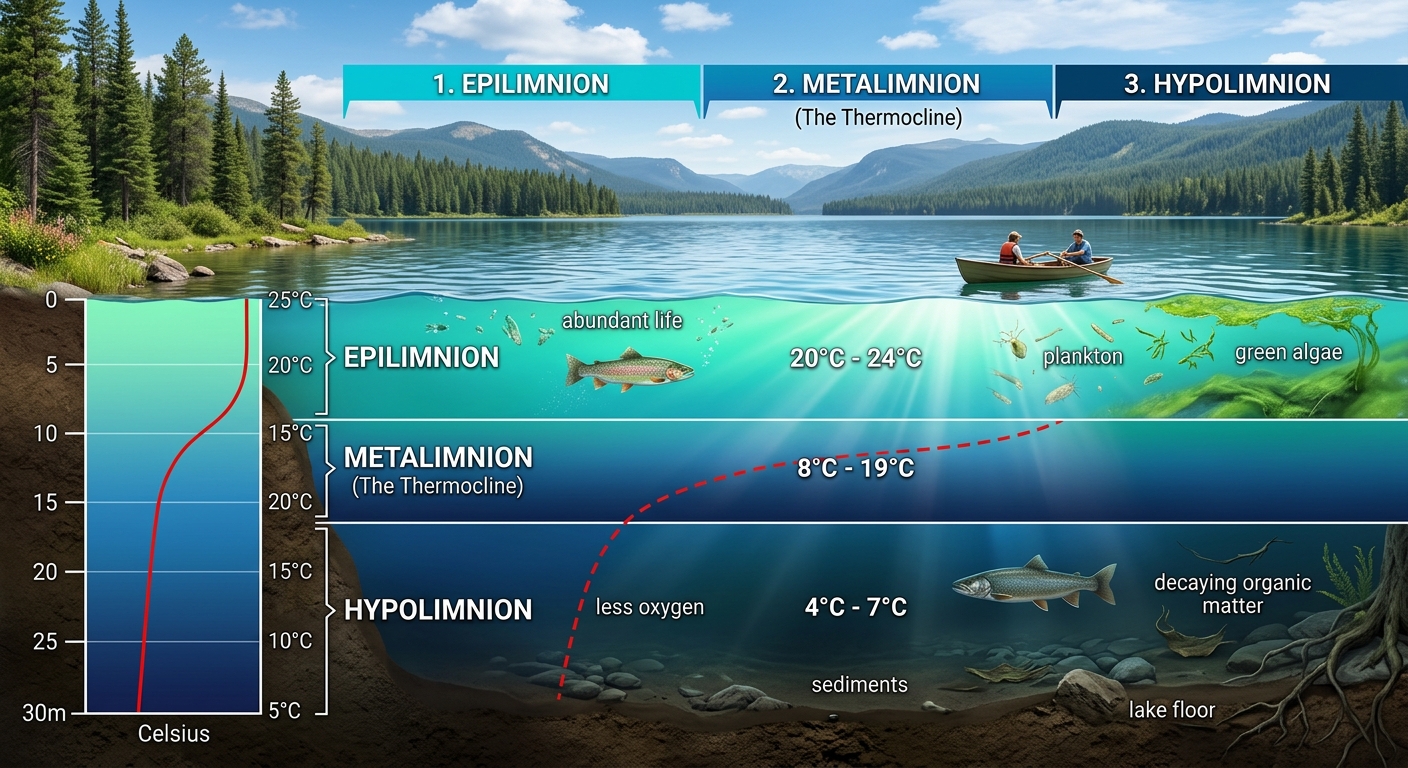
In temperate climates, many lakes develop thermal stratification during summer when surface water warms enough to remain less dense than deeper water. Whether a lake stratifies depends on depth, fetch, wind exposure, inflows, and basin shape, not a fixed depth cutoff. The warm upper layer (epilimnion) sits on top of a colder bottom layer (hypolimnion), separated by a sharp temperature transition called the thermocline.
Spring and fall turnover events occur when surface temperatures change enough to break stratification. Wind then mixes the entire water column. Turnover redistributes oxygen, nutrients, and heat from top to bottom.
Temperature profiles taken at multiple depths reveal the thermal structure of your lake at any given time. Knowing where the thermocline sits tells you how much of the water column is available as fish habitat.
- Stratification depends on depth, wind, fetch, and basin shape, not a universal depth threshold.
- The thermocline can shift depth through the season.
- Spring and fall turnover events mix the full water column, temporarily equalizing temperature and DO.
- Temperature profiles are more informative than single surface readings.
How water temperature connects to management decisions
Treatment timing is influenced by water temperature, but effective windows vary by product, organism, and site. Biological products that use beneficial bacteria to digest organic muck are generally more active in warmer water; follow product labels and site-specific monitoring rather than a single temperature rule. Applying treatments too early in spring, before organisms are active, may reduce effectiveness.
Aeration system design also depends on temperature patterns. In lakes that stratify, the goal may be to destratify the water column or to add oxygen to the hypolimnion without disrupting the thermal structure.
Monitoring temperature alongside other parameters gives you the context to interpret your data correctly. A sudden drop in dissolved oxygen makes more sense when you see that water temperature jumped five degrees that same week.
- Time biological treatments using product guidance, temperature trends, and field observations rather than a fixed temperature cutoff.
- Aeration design choices depend on whether the goal is full destratification or targeted hypolimnetic oxygenation.
- Continuous temperature monitoring reveals when stratification sets up and breaks down.
- Pair temperature data with dissolved oxygen and nutrient readings for a complete picture.