
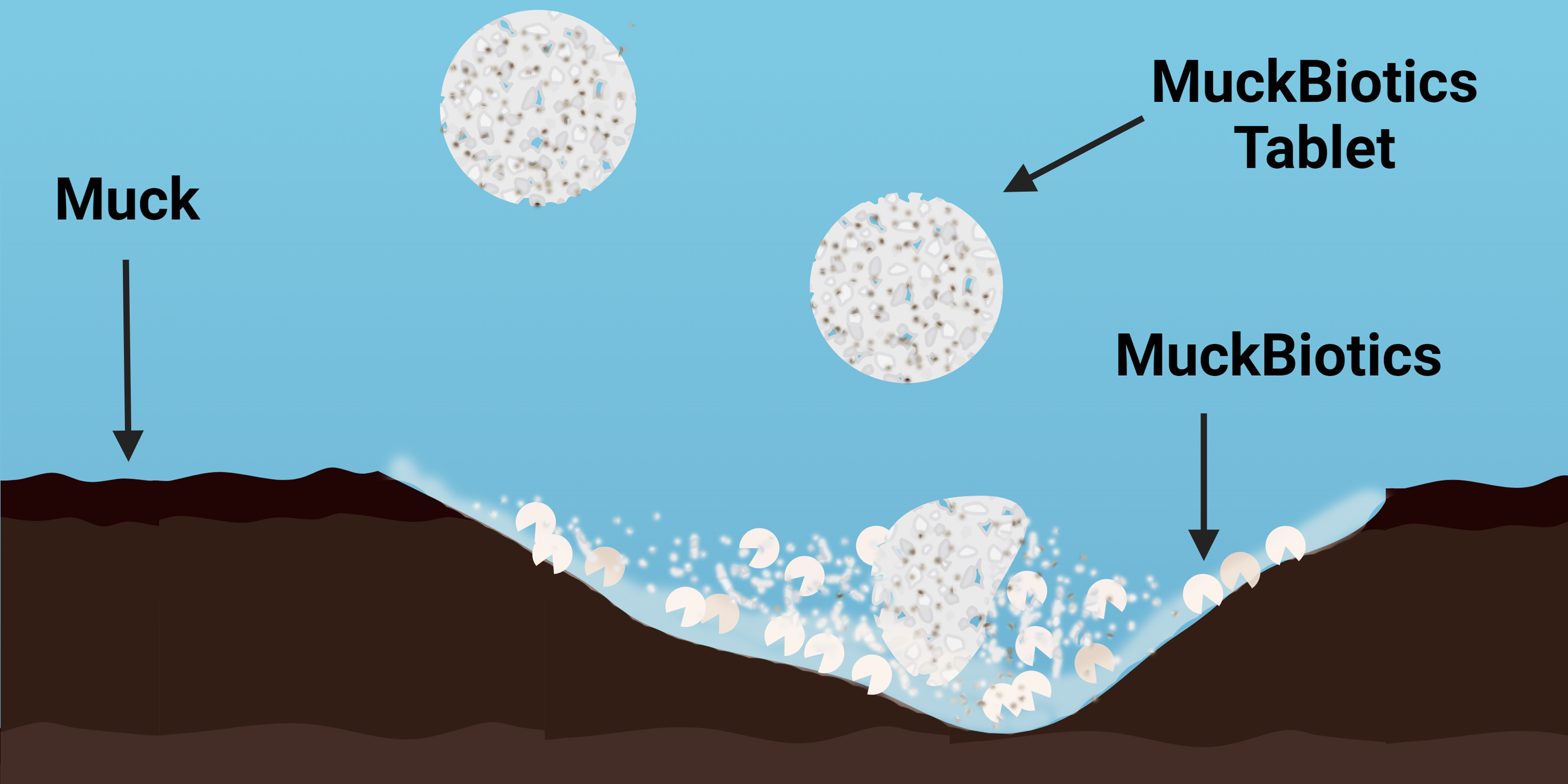
The bacteria break down organic matter through enzymatic digestion
When MuckBiotics pellets reach the pond bottom, they dissolve slowly and release billions of beneficial bacteria directly into the muck layer. These bacteria are not one species, they are a consortium of strains selected for their ability to decompose different types of organic material.
The bacteria secrete extracellular enzymes into the surrounding sludge. These enzymes break apart complex organic molecules: cellulase breaks down cellulose from leaves and plant material, protease breaks down proteins from fish waste and dead organisms, lipase breaks down fats and oils from algae and organic runoff. Once these large molecules are broken into smaller compounds, the bacteria absorb them as food. The metabolic end products are primarily carbon dioxide and water, the muck is literally being converted into gas and liquid that dissipate into the water column and atmosphere.
- Multiple bacterial strains work together to decompose different organic materials.
- Enzymes break cellulose, proteins, and fats into smaller absorbable compounds.
- End products are carbon dioxide and water, the muck is consumed, not just relocated.
- This is the same biological process that happens naturally, but concentrated and accelerated.
Why the pellet delivery form matters
Many pond bacteria products are sold as liquids that you pour into the water. The problem with liquid application is dispersion, the bacteria spread throughout the water column rather than concentrating where the muck actually is. The water column is not where the problem lives.
MuckBiotics pellets are formulated to be dense enough to sink through the water within minutes and embed into the sludge layer on the bottom. This puts the bacteria in direct physical contact with the organic material they need to digest. It is the difference between spreading antibiotics into the air of a room versus applying them directly to a wound. Direct contact with the target material matters.
- Pellets sink through the water column and embed in the muck layer.
- Direct contact between bacteria and organic material accelerates decomposition.
- Liquid bacteria products often stay suspended rather than reaching the sediment.
- The pellet dissolves slowly, releasing bacteria over time rather than all at once.
Three conditions that determine how fast the bacteria work
Dissolved oxygen is the most important factor. Aerobic bacteria, the kind that decompose organic matter efficiently, need oxygen to metabolize. In well-oxygenated water, aerobic decomposition can be many times faster than anaerobic breakdown. Ponds with poor oxygen at depth (common in stratified or stagnant water) will see slower results because the bacteria cannot operate at full capacity.
Water temperature is the second major factor. Bacterial metabolism roughly doubles for every 10°C (18°F) increase within their active range. Below about 50°F (10°C), activity slows dramatically. Between 60°F and 85°F (15-30°C), conditions are ideal for active muck digestion. This is why treatment programs focus on the warm season.
The third factor is contact time: how long the bacteria maintain a strong presence in the muck layer. A single application establishes an initial population, but that population needs reinforcement. Regular applications every two to four weeks maintain the bacterial concentration needed for sustained decomposition throughout the treatment season.
- Dissolved oxygen: aerobic conditions at the sediment layer dramatically improve decomposition speed.
- Water temperature: bacteria are most active between 60°F and 85°F (15-30°C).
- Contact time: regular applications maintain the bacterial population needed for sustained results.
What happens at the pond bottom over a treatment season
In the first few weeks after application, the bacteria are colonizing the muck matrix and multiplying. There is no visible change from above during this period. The bacteria need time to establish themselves in sufficient numbers to make a noticeable impact on the organic layer.
After several weeks of consistent treatment in warm water, some owners notice reduced odor along the shoreline, this is often the first observable sign of active decomposition. You may also see small gas bubbles rising from treated areas as the bacteria release trapped gases from the sludge layer during digestion. This is normal and indicates active breakdown.
By the end of a full warm-season treatment program with regular applications, the sludge layer in treated areas should be measurably thinner. Using a simple muck probe or graduated pole before and after the treatment season gives you objective data on how much muck depth has been reduced.
- Weeks 1-3: bacteria colonize and multiply in the muck layer: no visible change yet.
- Weeks 4-8: reduced odor and occasional gas bubbles indicate active decomposition.
- End of season: measurable sludge depth reduction in consistently treated areas.
- Second season: faster ramp-up as residual bacteria re-establish in spring.