
Before your first application
Walk the shoreline and identify where the muck is worst. Push a pole or muck probe into the bottom in several spots to measure how deep the soft organic layer is. Note which areas have the strongest odor and the softest bottom. Write down these baseline measurements, they are how you will track whether the treatment is working at the end of the season.
Check water temperature with a pond thermometer. MuckBiotics bacteria become active above roughly 50°F (10°C) and work best between 60°F and 85°F (15-30°C). Starting treatment too early in cold water wastes product because the bacteria cannot metabolize effectively. In most of the U.S., the warm-season treatment window runs from late spring through early fall.
- Measure sludge depth in 5-10 spots with a pole or muck probe: record the baseline.
- Note the worst areas: inlets, tree lines, sheltered coves, shoreline with odor.
- Check water temperature: wait until it holds above 50°F (10°C) before starting.
- Take photos of the shoreline for visual before-and-after comparison.
Applying pellets for broad coverage
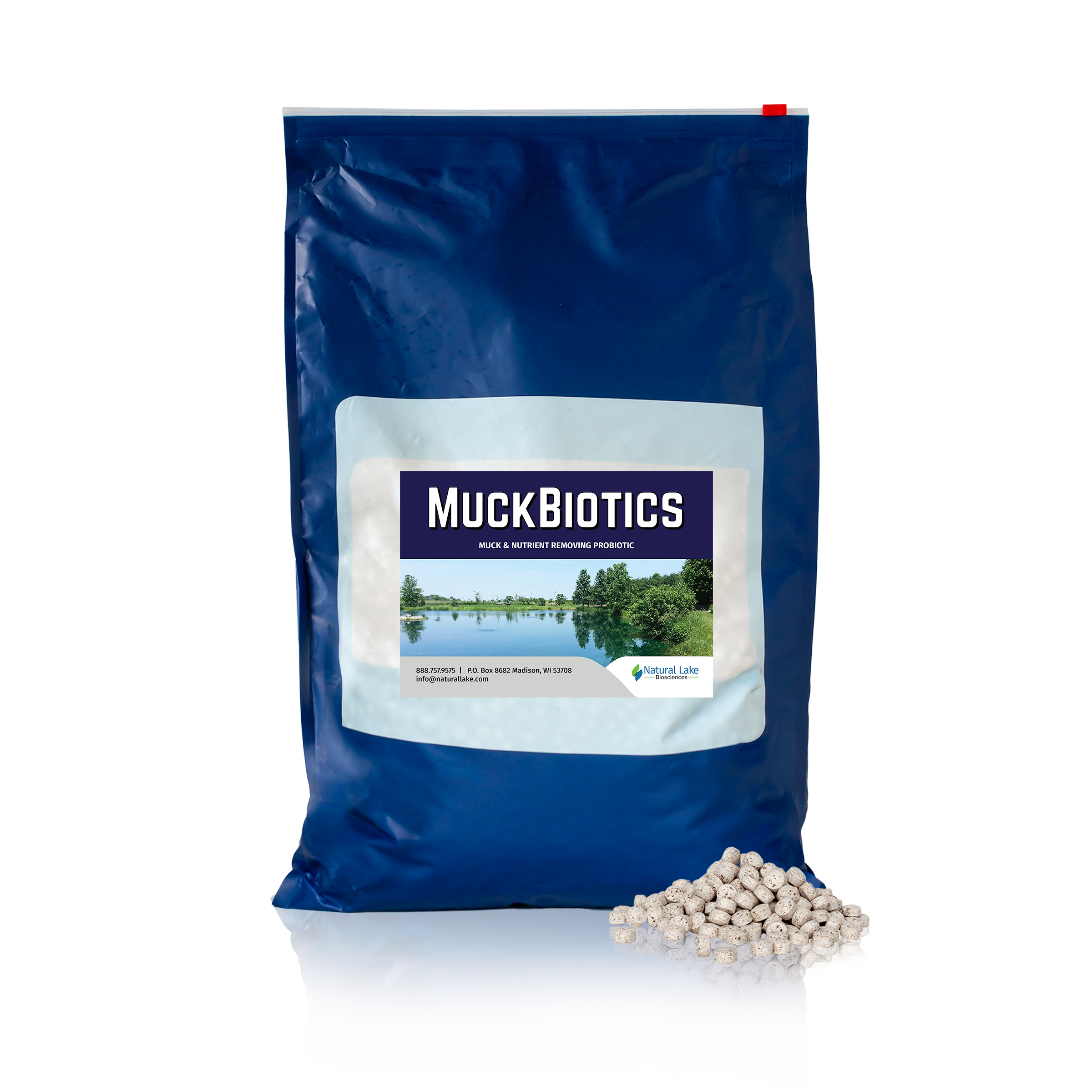
Open a 30 lb bag and broadcast pellets over the water surface by hand. Scoop handfuls and throw them in an arc pattern to get even distribution across the treatment area. Focus more pellets on the zones where you measured the deepest sludge and noticed the worst odor. The pellets will sink to the bottom within minutes.
For small ponds (under an acre), you can apply from the shoreline by walking the perimeter and tossing pellets outward. For larger ponds or lakes, work from a boat, load pellets into 5-gallon buckets and broadcast while motoring slowly through the treatment zone. One 30 lb bag covers up to half an acre per application.
- Broadcast by hand in an arc pattern for even coverage.
- Concentrate more product on the areas with the heaviest muck.
- Small ponds: apply from the shoreline by walking the perimeter.
- Larger water: apply from a boat using 5-gallon buckets.
Using tablets for targeted treatment
Tablets are more concentrated than pellets and designed for specific problem areas rather than broad coverage. Drop them directly into the water at docks, swim zones, beach areas, and shoreline spots where muck accumulation is heaviest.
Space tablets roughly 6 to 10 feet apart along the area you want to treat. The tablets sink immediately and concentrate bacterial activity right where you need it most. Many owners use tablets alongside a pellet program: pellets for general coverage, tablets to give extra attention to the spots that matter most.
- Drop tablets directly into the water at specific problem locations.
- Space them 6-10 feet apart along docks, beaches, and swim areas.
- Tablets sink immediately and concentrate treatment at the drop point.
- Use alongside pellets for a combined broad-and-targeted approach.
Building a treatment schedule
Plan to reapply every two to four weeks throughout the warm season. Biweekly applications maintain a stronger and more consistent bacterial presence in the muck layer. Monthly applications are sufficient for lighter organic loading. The goal is sustained biological activity, not occasional bursts.
A typical warm-season program runs 4 to 8 applications between spring and early fall, depending on your climate and treatment intensity. Reduce the amount of fresh organic debris entering the pond by redirecting grass clippings, clearing leaf accumulation from the shoreline, and managing overhanging vegetation. This reduces the new material the bacteria have to keep up with.
- Reapply every 2-4 weeks during the warm season (above 50°F water temperature).
- Biweekly gives better results than monthly for heavier muck problems.
- A full season typically involves 4-8 applications depending on climate.
- Reduce fresh debris entering the pond to help the treatment keep pace.