
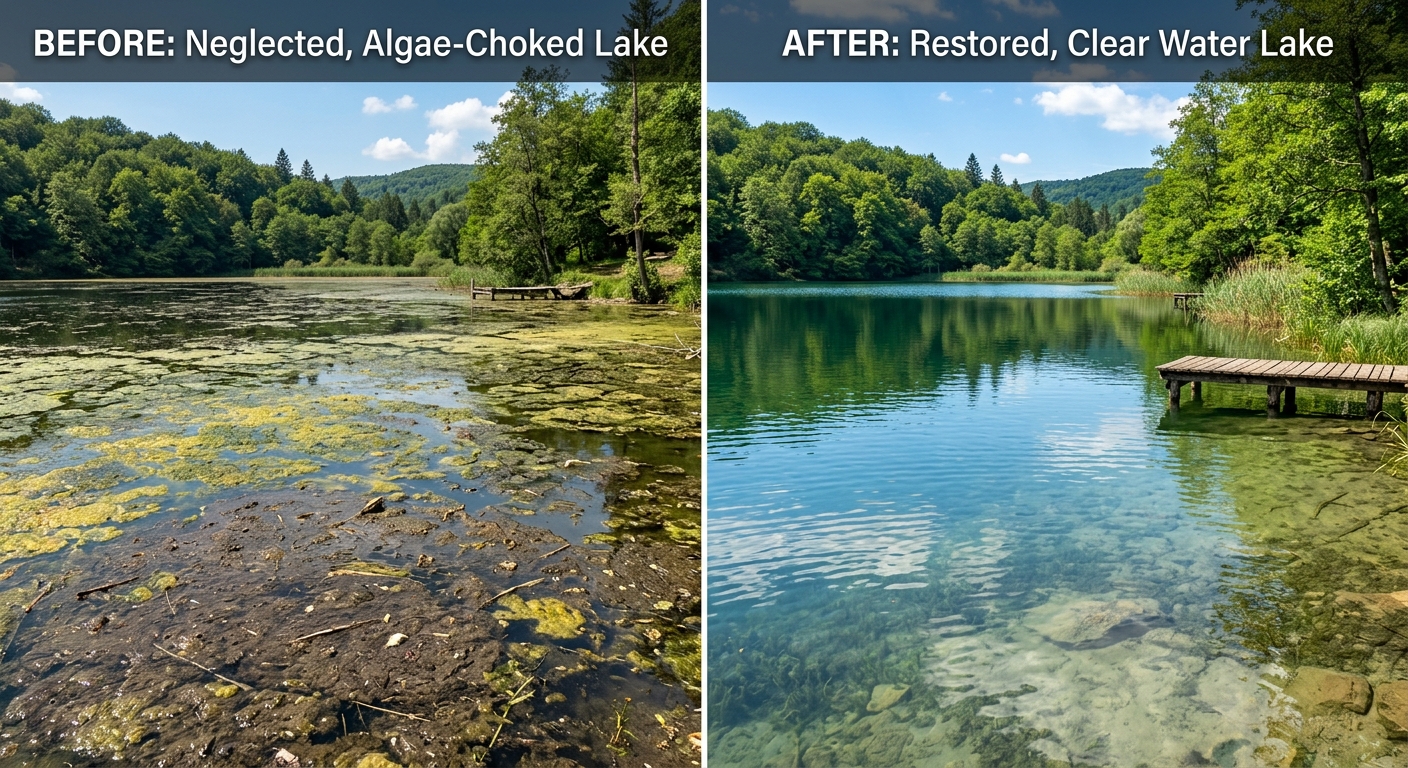
Why golf course ponds accumulate organic muck faster
Golf courses create conditions that continuously feed organic sludge into their ponds. Grass clippings from frequent mowing operations blow or wash into water features. Spring and fall fertilization programs send nitrogen and phosphorus into the ponds via surface runoff, fueling organic growth. Maintained tree lines contribute leaf litter. Resident waterfowl add waste.
This above-average organic loading produces thicker sludge accumulation, faster odor development, and more visible water quality issues than a comparable-size pond in a natural or lightly maintained setting. A half-acre golf course pond may develop muck conditions that would take years to appear in a similar-size farm pond.
- Grass clippings from mowing are a major ongoing organic input.
- Fertilizer runoff accelerates organic growth and sludge formation.
- Tree line maintenance creates seasonal leaf litter pulses.
- Waterfowl populations on maintained ponds add continuous organic waste.
Scheduling treatment around course operations
Applications are quick: broadcasting pellets from the shoreline or placing tablets takes minutes per pond. But on an active golf course, timing matters. Schedule applications during off-peak windows: early morning before play begins, on maintenance days, or during periods when the area is not in use for events.
Coordinate with the grounds crew so treatment applications do not interfere with mowing, irrigation, or chemical spray schedules. Many courses designate one morning per week or bi-week for pond treatment across the property. This creates a predictable schedule that both the grounds team and the treatment program can work around.
- Apply during early morning, maintenance days, or off-peak periods.
- Coordinate with the grounds crew to avoid conflicts with mowing and spraying.
- A fixed treatment day (e.g., biweekly Tuesday mornings) creates predictable scheduling.
- Applications take minutes per pond: minimal disruption to course operations.
Irrigation pond quality and muck treatment
Ponds used as irrigation water sources have additional considerations. Thick organic sludge can affect irrigation pump intake, pulling in decomposing material, clogging filters, and introducing organic particulates into the irrigation water that ends up on greens and fairways. The odor issue is also more noticeable when organic-laden water is being sprayed across turf.
Maintaining a biological treatment program in irrigation ponds helps keep the water cleaner at the intake point, reduces the organic particulate load entering irrigation equipment, and minimizes the odor of applied irrigation water. This is often the pond that gets treatment priority on a course, not for aesthetics, but for operational reasons.
- Organic sludge near pump intakes can clog filters and degrade irrigation water quality.
- Odor from organic-laden irrigation water is noticeable on greens and fairways.
- Biological treatment at the irrigation pond reduces operational headaches.
- Irrigation ponds often get first treatment priority for practical, not cosmetic, reasons.
Managing multiple ponds across a course
Most golf courses have 3-8 water features of varying sizes and conditions. Treating all of them simultaneously may not be practical or necessary in the first season. A sensible approach: prioritize the irrigation source pond and the ponds with the worst visible or odor problems, then add remaining ponds to the program in subsequent seasons.
Build a treatment calendar that covers all active ponds with their application schedules. LakeTech can help design a multi-pond program that distributes the workload and product cost across the season while giving the highest-priority ponds the most intensive attention.
- Prioritize the irrigation source pond and worst-condition ponds first.
- Add lower-priority ponds to the program in subsequent seasons.
- Build a calendar that covers all active ponds with their specific schedules.
- LakeTech can design a multi-pond program for your specific course layout.