
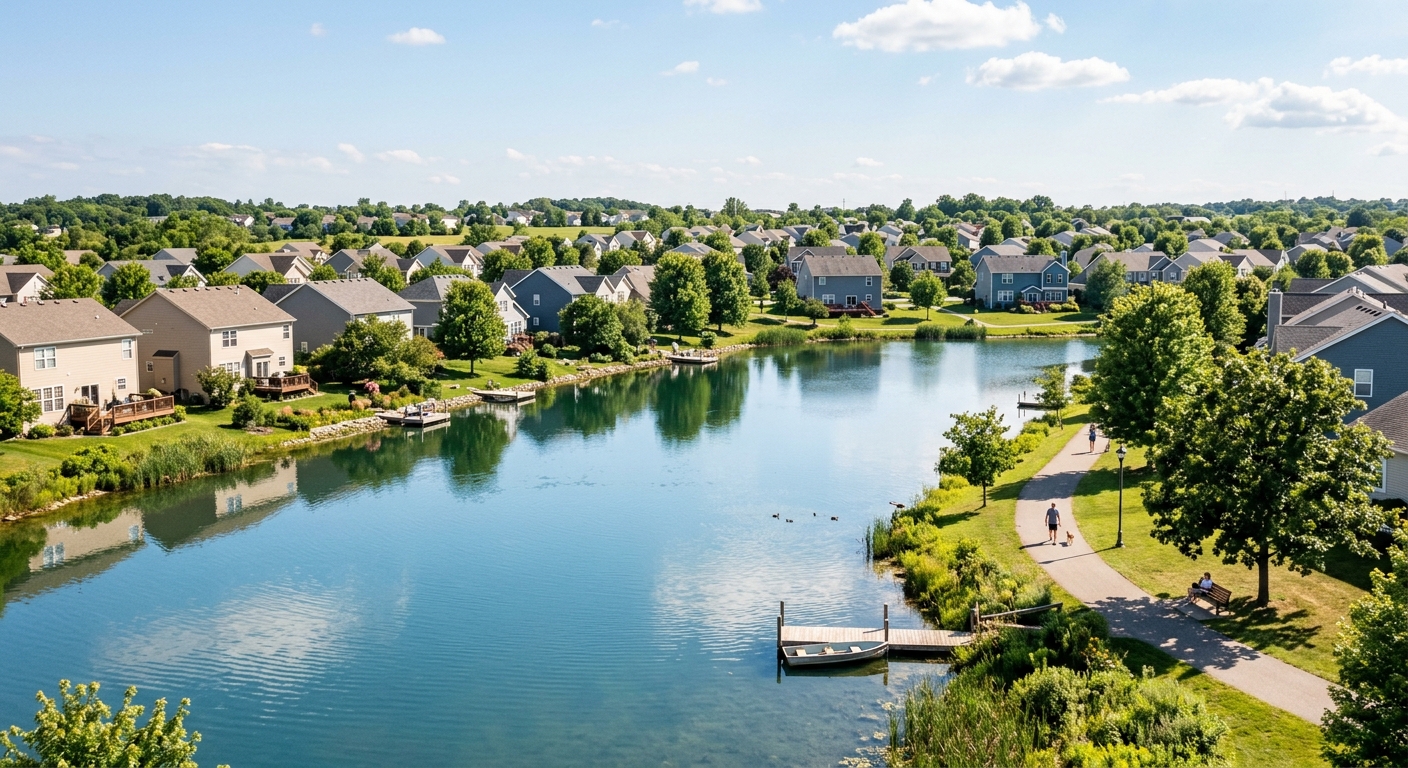
Where muck accumulates in a typical pond
Organic material does not distribute evenly across a pond bottom. It concentrates in predictable patterns. Inlet areas where runoff enters the pond collect nutrient-rich sediment. Shoreline stretches beneath overhanging trees accumulate leaf litter. Shallow, sheltered coves trap floating debris. The downwind shore collects organic material pushed across the surface by prevailing wind.
Understanding your pond's muck pattern helps you target treatment. Walk the shoreline and probe the bottom in 8-10 spots. You will likely find that some areas have inches of soft organic sludge while others are relatively clean. Concentrate pellets and tablets on the heavy areas rather than spreading product uniformly across the entire bottom.
- Near inlets: runoff deposits nutrient-rich organic material where it enters the pond.
- Under tree lines: leaf fall is the largest single source of organic muck in many ponds.
- Sheltered coves: low water movement allows debris to settle rather than disperse.
- Downwind shore: prevailing wind pushes floating organic debris to one side.
Pond characteristics that affect treatment planning
Fish population matters. A heavily stocked fishing pond generates more organic waste from fish excrement and uneaten food than a lightly used decorative pond of the same size. That ongoing organic input means a heavier treatment program and more patience.
Surrounding landscape matters. A pond surrounded by mature deciduous trees receives substantially more leaf litter than one in an open field. A pond bordered by mowed lawn collects grass clippings. A pond fed by agricultural runoff receives nutrient loads that accelerate organic growth. Each of these inputs affects how quickly new muck forms and how intensively you need to treat.
Pond depth affects oxygen conditions. Shallow ponds (under 6 feet) are usually well-mixed by wind and maintain adequate dissolved oxygen for biological treatment. Deeper ponds may stratify in summer, creating low-oxygen conditions at the bottom that slow bacterial activity, these benefit from supplemental aeration.
- Fish population: more fish means more organic waste and heavier treatment needs.
- Tree and lawn proximity: primary sources of leaves and grass clippings entering the pond.
- Water source: spring-fed ponds have different characteristics than runoff-fed ponds.
- Depth: ponds over 6-8 feet deep may stratify and benefit from aeration alongside treatment.
Treatment sizing for common pond sizes
For ponds under half an acre, one 30 lb bag of MuckBiotics per application provides full coverage. For ponds from half an acre to one acre, plan for two bags per application. For one to two acres, three to four bags. These are baseline rates for moderate organic loading: ponds with particularly heavy sludge may benefit from a higher initial loading rate for the first couple of applications.
Most pond programs run 4-8 applications per warm season, depending on climate and how long the water stays above 50°F. A typical half-acre residential pond might use 6-8 bags over a full season. LakeTech can help refine these numbers for your specific situation.
- Under half acre: 1 bag (30 lbs) per application.
- Half acre to one acre: 2 bags per application.
- One to two acres: 3-4 bags per application.
- Full season: 4-8 applications during the warm-water months.
When a pond needs more than biological treatment
If the muck layer is extremely deep, more than 2-3 feet of soft organic material, biological treatment alone may take many seasons to produce significant depth recovery. In those cases, partial mechanical removal (mini-dredging, suction removal) to reduce the sludge to a manageable thickness, followed by biological treatment for ongoing maintenance, may be a more practical path.
If the pond bottom is primarily inorganic, clay, silt, sand, or fill material, biological treatment will not make a meaningful difference because bacteria cannot digest mineral sediment. And if the pond has structural problems (leaking dam, eroded banks contributing sediment), those need to be addressed first regardless of the muck treatment approach.
- Sludge over 2-3 feet deep: consider partial mechanical removal before starting biological treatment.
- Inorganic sediment: grab a handful, if it's gritty or clay-like, biological treatment won't help.
- Structural problems: fix leaks and erosion sources before investing in muck treatment.
- When in doubt, a conversation with LakeTech can help you decide what your pond actually needs.